

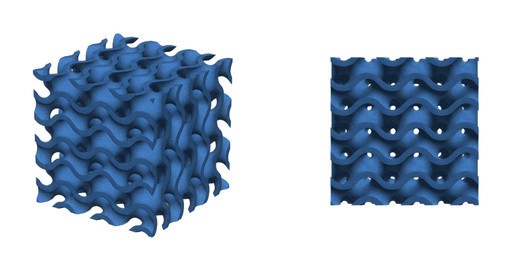
This week, the theme is function. The field is quietly shifting from printing shapes to printing behavior, letting geometry and materials, not just the device, do the medical work. Our big thing makes the case at its most literal: a 3D-printed lattice that could reinvent the artificial lung by treating architecture as the active ingredient. The same logic runs through the rest of the issue: bioprinted tissue that grows its own blood supply, an FDA-cleared denture resin winning on toughness rather than novelty, $30 patient-shaped MRI coils, and open-source prosthetics built to reach the people standard devices miss. We close in orbit with a podcast on why microgravity makes tissue easier to build, featuring CSO of the International Space Station, Dr. Michael Roberts, and an event on where biomaterials go next.
The big thing
The artificial lung may be an architecture problem

I would not call ECMO “artificial lung” just as I would not call dialysis “artificial kidney”. That said, ECMO is the closest thing we have: a machine that oxygenates blood in place of the lungs, but only for a while. For half a century, the artificial lung has been a bundle of hollow fibers: pack thousands of gas-permeable straws into a housing, push blood past them, and let oxygen diffuse in. It works well enough that ECMO keeps the sickest patients alive, and well enough that the ECMO machine market still runs almost entirely on hollow-fiber oxygenators. The total market is roughly $0.65 billion in 2025 and is projected to reach ~$0.86 billion by 2030. “Well enough” is the tell. Blood threads unevenly through a fiber bundle, pooling in dead zones where it clots. This means that patients would need continuous anticoagulation, which makes them bleed. Additionally, the device stays outside the body as a bridge rather than a destination. A German-Dutch team led by Hannover Medical School’s Bettina Wiegmann recently proposed in the August issue of Advanced Materials that a 3D-printed gas-exchange membrane with a triply periodic minimal surface (TPMS) could solve the problems posed by hollow fibers and advance our ambition of an artificial lung. TPMS is a continuous, mathematically defined lattice that dictates where blood flows, how thin the diffusion barrier is, and where clots can’t gather. In simulation, optimized designs moved on average up to ~88% more oxygen than conventional fiber bundles, with smoother flow and fewer stagnation zones. That said, while architecture is the central theme in this paper, the researchers also included additional design elements, from printable silicone elastomers that can be made into membranes thin enough to breathe; a living endothelial lining made the membrane less thrombogenic; and an ambitious CT-derived geometry hints at a lung shaped to fit one patient’s chest.
The holy grail here is an implantable lung for the many and increasing number of end-stage patients who will never receive a donor organ. However, if the architecture is the active ingredient, then the incumbents’ fiber-winding lines look more like a legacy asset than a moat. History suggests the architecture is the easy part. ALung Technologies spent 25 years and north of $100 million turning a University of Pittsburgh lab device into the Hemolung Respiratory Assist System — FDA De Novo clearance in late 2021, acquired by LivaNova roughly six months later, and still a niche CO2-removal box rather than a lung. Draper has been building biomimetic microfluidic oxygenators since 2010 on NIH and Army money and reached clinical-scale flow in 2023 at 750 mL/min, the highest reported for a microfluidic device — elegant physics, no product. United Therapeutics and 3D Systems, partners since 2017, printed a lung scaffold of 44 trillion voxels that demonstrated gas exchange in animals in 2022 and predicted human trials “in under five years”; that window has quietly closed. OptiLung, a Texas-based early-stage startup, is commercializing a single-part, single-material 3D-printed oxygenator with a branching manifold that routes blood through vasculature-like channels and eliminates stagnant zones where hollow fibers clot. However, while the geometry is solved on the bench, questions about biocompatibility, efficacy, scalability, reimbursement, and more remain to be answered. Caveats abound here too: the results of this paper are in silico, early-stage, and no patient has been near it. Nonetheless, this is a paper worth reading and thoughts worth contemplating. Sources: Pflaum et al., “From Fiber Bundles to Architected Membranes,” Advanced Materials (2026), doi.org/10.1002/adma.74361.
Regulatory watch
- Carbon’s DB 4000 denture base resin clears FDA and meets ISO 20795-1 (Hi-Impact) — An FDA-cleared, ISO 20795-1 high-impact resin for 3D-printed dentures on Carbon’s M-Series; the company reports a work of fracture ~31% above the category leader and 97% global accuracy within 130 microns. (Company press.)
Clinical & research
- Bioprinted vascularized soft-tissue flaps with an integrated arterial-venous loop (Cell Biomaterials, via PubMed) — A muscle-and-fat flap bioprinted with its own printed arteriovenous loop for direct microsurgical hookup – a concrete step toward vascularized reconstruction.
- 3D-printed dissolving microneedles co-deliver curcumin and 5-FU for skin cancer (Advanced Healthcare Materials, via PubMed) — One-step DLP printing loads both drugs into a single dissolving array (>95% insertion); a formulation-and-process result, with biological validation still to come.
- A validated 3D-printed liver model for endoscopic-ultrasound (endo-hepatology) training (Surgical Endoscopy, via PubMed) — A CT-derived, tissue-free liver phantom showed strong content and face validity (index 0.85) across 16 endoscopists; vascular realism is the acknowledged next fix.
- miRNA-programmed spheroids bioprinted for vascularized bone regeneration (Chemical Engineering Journal) — Penn State placed stem-cell spheroids carrying bone (miR-148b) and vessel (miR-210) cues into scaffolds, improving vascularized bone repair in mice.
Also this week
- Recycled medical-grade plastics as a route to neurosurgical tools and implants in LMICs (Cureus) — Narrative review makes the case that locally recycled, low-cost plastics can widen access where imported filaments are cost-prohibitive.
- Custom 3D-printed MRI receive coils, ~$30 and under 10 minutes (Digital Journal) — USC prints patient-shaped coils reporting ~4x more image contrast than commercial units – aimed first at infants.
- Rady Children’s 3D lab models donor-heart fit for pediatric transplants (KPBS) — Physical and virtual models test whether a larger donor heart fits a child’s chest, working around the pediatric-donor shortage.
- Stratasys renews its 3D-printed prosthetics partnership with Limbitless (PlasticsToday) — A 12-year collaboration extends with a sustainability focus (a certified pre-owned printer) and STEAM access.
- TOM: 1,200 open-source, zero-patent assistive-tech designs (3D ADEPT) — Tikkun Olam Makers cuts assistive-device costs 80-99% using volunteer designers and desktop printers across 36 countries.
- Adelaide University to build multi-material biomimetic dental training models (VoxelMatters) — An AU$800K, 18-month project with Fusetec and Australia’s AMCRC to replicate how tissue behaves during procedures, not just its anatomy.
- A bioactive 3D-printing ink from Tel Aviv University (3DPrinting.com) — Holds print precision while intrinsically promoting cell adhesion and adding antibacterial activity.
- When will bioprinting become a therapy? A regulatory reality check (Frontiers in Bioeng. & Biotech.) — Review argues the path to the clinic runs through regulatory and operational hurdles, not just bench science.
- An undergraduate tunes a 3D-printing polymer for safer implants (VCU News) — VCU’s Jazlyn Lopez Silva is refining an implant-safe printing material; fibroblast testing is next.
From 3DHEALS
Podcast: Bioengineering in microgravity, with Dr. Michael Roberts (ISS National Lab) — Episode 123 of The Lattice Podcast: the ISS National Laboratory’s chief scientist on why removing gravity removes the scaffold problem that makes thick, vascularized tissue so hard to bioprint on Earth – from Redwire’s BioFabrication Facility to Auxilium’s orbital nerve-repair implants.
Event (Sep 10): Biomaterials Frontier — A 3DHEALS webinar on the defining shift of 2026 – from printing structure to printing function – convening researchers, founders and industry leaders across soft function-first bioresins, ion-releasing ceramics and bioactive glass, and titanium and titanium-tantalum lattices. Register to attend.
Comments