

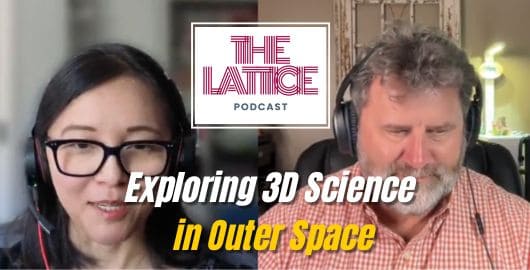
For 25 years, humans have continuously manned the International Space Station. Today that same microgravity environment is becoming a laboratory for building human tissue, studying disease, and manufacturing biological products that can be impossible to make on Earth. Dr. Micheal Roberts, Chief Scientific Officer of the International Space Station National Laboratory, explains how on Earth, gravity forces bioprinted tissue to collapse before it can support itself. In microgravity that constraint disappears and biological structures hold their shape with no scaffold at all. This single physical fact has turned the ISS into the proving ground for manufacturing thick, vascularized human tissue. He traces the arc from space-grown protein crystals to Redwire’s BioFabrication Facility and Auxilium Biotechnologies’ nerve-repair implants, which printed eight devices in roughly two hours in orbit. With astronauts supporting 200 to 400 experiments during a typical six-month mission and the ISS approaching its planned end around 2030, Dr. Micheal Roberts makes the case for a new generation of commercial platforms that could turn low Earth orbit into a biomanufacturing hub. Now is the moment.
⚠️ Disclaimer:
This podcast is for educational and informational purposes only. The views expressed do not constitute engineering, medical, or financial advice. The technologies and procedures discussed may not be commercially available or suitable for every case. Always consult with a qualified professional.
About Our Guest:

Dr. Michael Roberts is the Chief Scientific Officer of the International Space Station National Laboratory and Vice President at the Center for the Advancement of Science in Space (CASIS). Before joining CASIS in 2013, Michael worked as a microbial ecologist, principal investigator, and research group lead at the Kennedy Space Center. Prior to arriving at NASA-KSC in 1999, Michael completed an undergraduate degree in biology at Maryville College, a doctorate in microbiology at Wesleyan University and post- doctoral research at the Center for Microbial Ecology at Michigan State University. Lowry holds a PhD in biomedical engineering from Tulane University, sits on the 3Rs Collaborative and FNIH Validation and Qualification Network, and has authored 6 patents, 20+ publications, and 100+ scientific presentations.
Key Topics
A microbiologist’s unexpected journey from Kennedy Space Center to the ISS National Laboratory
Why 25 years of continuous human presence in space have made this the right moment for biomanufacturing
Protein crystallization and the origins of biological manufacturing in space
The scaffold problem and microgravity’s unique advantages for 3D tissue printing
Engineering bioprinters for space, from heat dissipation to fluid separation and microfluidics
Redwire’s BioFabrication Facility, Auxilium’s DLP technology, and the move beyond extrusion
What happens to cells, organoids, and tissues when gravity is removed
How microgravity can accelerate models of aging, cancer, and disease progression
NASA’s vascular tissue challenge and the race to create thick, functional, vascularized tissue
Wake Forest’s liver and kidney bioprinting work and new collaborations emerging from space research
The partnerships bringing together NASA, academia, startups, pharma, and government
Life after 2030 and the transition from the ISS to commercial space platforms
Varda, Starfall, and falling launch costs are reshaping access to low Earth orbit
The potential of space-based research for aging, cancer, longevity, and regenerative medicine
The biggest barriers to space biomanufacturing, including cost, logistics, regulation, and quality control
Orbital Edge, startup funding, and opportunities for the next generation of space entrepreneurs
Timestamps:
0:00 Welcome And Guest Introduction
3:51 From Microbes To Managing ISS Science
6:14 Why Space Biomanufacturing Now
9:55 Protein Crystals And Better Drug Design
15:35 Why Bioprinting Changes In Microgravity
24:24 Engineering Printers For Space Reality
27:59 Organoids And 3D Cell Culture Gains
35:25 Vascularization Challenge And Thick Tissues
39:45 Partnerships That Make The Ecosystem Work
46:06 Post ISS Platforms And Lower Launch Costs
49:34 Biggest Blockers Cost Logistics Regulation
54:35 Orbital Edge And Advice For Builders
56:40 Closing Thanks And Disclaimer
Resources
🔗 Contact Dr. Michael Roberts
- Dr. Michael Roberts on LinkedIn
- Dr. Michael Roberts, ISS National Laboratory
- Michael Roberts at ASCEND
- ISS National Laboratory
- Center for the Advancement of Science in Space (CASIS)
🔗 Space Biomanufacturing, Research & Companies
- ISS National Lab BioFabrication Facility
- Redwire
- Auxilium Biotechnologies
- NeuroSpan Bridge
- Yes, Virginia, There is a National Laboratory in Space
- The New Alchemy of Space: Why We Cannot Leave Public-Private Partnerships Behind
- NASA In Space Production Applications (InSPA)
- NASA Vascular Tissue Challenge
- NASA Vascular Tissue Challenge Winners
- Wake Forest Institute for Regenerative Medicine
- Varda Space Industries
- Orbital Edge Accelerator
- ISS National Lab LEO Economic Development
- Biomanufacturing in Low Earth Orbit: A Paradigm Shift
- Biomanufacturing in Low Earth Orbit: Full Text
🔗 Learn More About 3D Bioprinting from 3DHEALS!
- 3D Bioprinting in Space?
- 3DHEALS 2020: Healthcare 3D Printing in Space, NASA, ISS
- 3D Bioprinting and Organoids
- 3D Bioprinting Vasculatures
- 3D Bioprinting for Regenerative Medicine
- 3D Printing for Cardiovascular Systems
- 3D Printing Organ-on-a-Chip & Microfluidic Devices
- 3D Printing and Microfluidics
- Interview with Elliot McAllister: 3D Printing Microfluidics
- 3D Bioprinting Heart & Cardiovascular System
Comments