

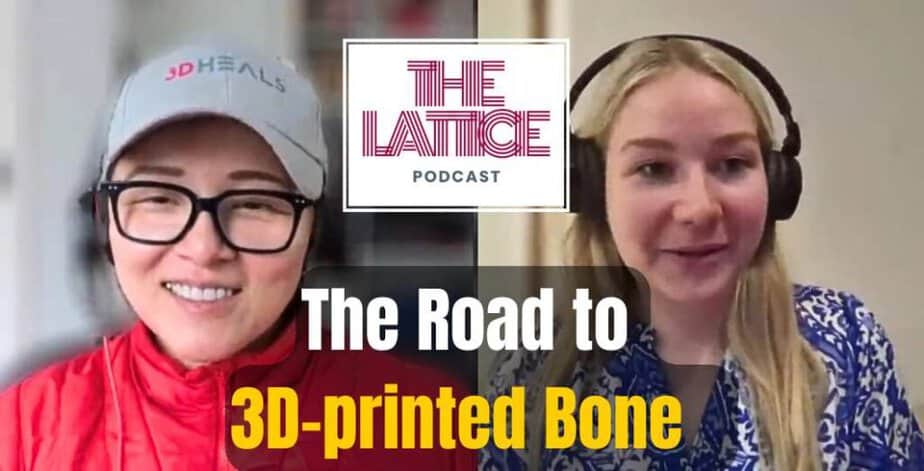
Ossiform is on track to bring the first 3D printed resorbable bone implant to the US market. The company’s preclinical data showed full bone regeneration in six months. Monica Wellejus, Chief Commercial Officer of Ossiform, joins The Lattice to explain how a company built to personalize bone implants for craniomaxillofacial surgeries pivoting to mass produced bone implant for foot deformity, and why hospital finance teams, not just the surgeons, may decide whether this technology actually reaches patients.
⚠️ Disclaimer:
This podcast is for educational and informational purposes only. The views expressed do not constitute engineering, medical, or financial advice. The technologies and procedures discussed may not be commercially available or suitable for every case. Always consult with a qualified professional
About Our Guest:
Monica Wellejus

Monica Wellejus is a technology commercialization strategist who has spent the past seven years working at the intersection of biomaterials and medical 3D printing. With an MA in Business, Language, and Culture, Monica entered the field from a non-technical angle but quickly became involved in all aspects of bringing bone regenerative solutions to market, from product development and quality control to regulatory pathways, evidence generation, and global commercialization strategies. She has been part of Ossiform® since 2019, where she manages the company’s commercial and go-to-market activities as the Chief Commercial Officer. Ossiform® develops 3D printed bioactive bone substitutes with an aim to improve bone healing outcomes, simplify complex procedures, and reduce complication rates in orthopedics and spine. Its novel 3D printing technology is further used to provide bone-mimicking 3D cell culture systems for improving the physiological relevance of in vitro models in bone and cancer research.
Email: mw@ossiform.com
Timestamps:
00:00 Intro | Why 3D printed bone has not reached patients yet
02:08 Meet Monica Wellejus and Ossiform
05:41 How Ossiform prints bone substitutes using β-TCP ceramics
10:12 The long road to FDA clearance and U.S. market entry
14:03 Why Ossiform moved away from personalized implants
18:26 Listening to surgeons changed everything
23:47 Flatfoot reconstruction and Ossiform’s first clinical products
30:18 Fundraising, commercialization, and building a MedTech startup
38: 54 The hidden decision-makers in healthcare adoption
46:31 The future of bone regeneration, AI, and point-of-care manufacturing
Key Topics
Monica’s pathway to becoming CCO of a deep-tech MedTech startup
Why a 40-year-old ceramic becomes something new when printed into a resorbable bone substitute
How synthetic consistency became Ossiform’s sharpest argument against donor bone
What a pig mandible study revealed about full bone remodeling in six months
Why 95% of surgeons want something off the shelf, not a custom implant
How foot deformity correction became Ossiform’s beachhead, chosen for fit not market size
Why hospital CFOs and value analysis committees are now as important as the surgeon
Why Ossiform pursued FDA clearance before a CE mark
Monica’s vision for point-of-care bone printing and AI-driven customization
Resources
🔗 Contact Monica Wellejus
- Monica Wellejus on LinkedIn
- Ossiform Official Website
- Ossiform on LinkedIn
- Ossiform on Youtube
- Email: mw@ossiform.com
🔗 Ossiform & 3D Printed Bone
- Research Protocols & P3D Scaffolds
- The Performance of 3D Printed Resorbable Implants in the Mandible of Pigs
- Democratizing 3D Bone Printing for Medical Innovations
🔗 Hear More from Monica
- 3DHEALS Interview: From Hope to Breakthrough – 3D Printed Bone Regeneration at Ossiform
- 3DHEALS Bench-to-Bedside Event Featuring Monica Wellejus
- Alpha Sophia Spotlight: How to Print Bone with Monica Wellejus of Ossiform
- LSI USA ’24: 3D Printed Resorbable Bone Implants
🔗 Selected Publications
- Ossiform Publications
- Scaffold Material–Architecture Design Rules Linking Mechanics and Early Osteogenesis in PCL/β-TCP Grid, Honeycomb, and Gyroid Lattices (2026)
- Characterization of 3D-Printed β-TCP Scaffolds with Enhanced Microstructure, Mechanical Properties, and Cell Compatibility (2024)
- Comparison of Off-the-Shelf β-Tricalcium Phosphate Implants with Novel Resorbable 3D Printed Implants in Mandible Ramus of Pigs (2022)
- Treating Mouse Skull Defects with 3D-Printed Fatty Acid and Tricalcium Phosphate Implants (2020)
- Simple Additive Manufacturing of an Osteoconductive Ceramic Using Suspension Melt Extrusion (2017)
🔗 Other Relevant Links
- TEDxWarwick: 3D Printed Bones — Why This Is the Future (Casper Slots)
- 3DHEALS Interview with Ossiform Co-Founder Casper Slots
- Materialise Case Study: Ossiform Creates Patient-Matched Bone Implants with 3D Printing
- 3DPrint.com: Ossiform Raises Funding for 3D Printed Bone Implants
- CELLINK × Ossiform: Launch of Ossi Ink
- ABHI U.S. Accelerator Program
- State of MedTech Podcast (Hosted by Omar Khateeb)
🔗 Relevant 3DHEALS Links
Comments