

In 2026, China is turning 3D printing, or additive manufacturing, into a mass-production industry. A new Ganzhou plant can build up to 50 metal printers a month, and Chinese makers exported 2.46 million consumer printers in the first four months of the year. The shift is now reaching medical 3D printing.
The scale of China’s build-out
This week Shenzhen-based Addireen opened a plant in Ganzhou that can build up to 50 metal printers a month. A week earlier, Eplus3D finished a Beijing factory sized for more than 300 large metal systems a year. China shipped 2.46 million consumer printers abroad in the first four months of 2026, up 44.7%. Metal leader BLT grew revenue about 40% last year, per company figures compiled by Tianxia Gongchang.
Now the West. 3D Systems posted a flat $94.6M quarter. (Healthcare, up 6.9%, carried it.) Stratasys won a patent case against Bambu Lab in court, but no sales ban followed.
Where it reaches medicine
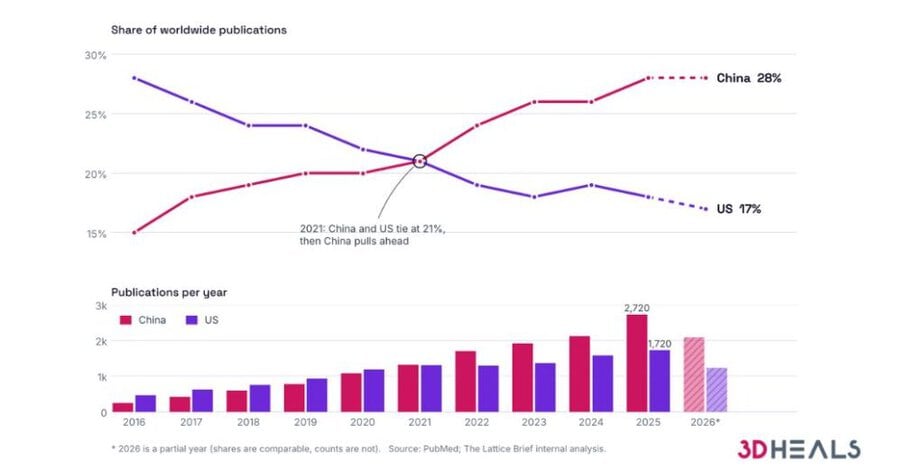
Based on our internal research focusing on keywords related to “3D printing”, “additive manufacturing”, and “bioprinting”, the number of publications in PubMed has also grown significantly from China in the last 10 years (see graph below). The percentage share of articles published has steadily increased to 28%. Surprisingly, the percentage share of US publications has been declining to 17%. One could argue that the quality of the Chinese studies might not meet certain academic standards, and I agree with that skepticism especially given high retraction rate. However, these are numbers and trends to keep an eye on.
Across the United States, the European Union, and China, the volume of academic medical device research, including hardware, diagnostic hardware, implants, and digital health software successfully reaching commercial channels reveals a steep translation funnel restricted by high capital demands and heavy engineering-to-clinical validation hurdles. In the United States, robust private venture networks and experienced technology transfer ecosystems drive an estimated 10% to 15% of university medical device disclosures to achieve commercial licensing or startup spin-out formation, although fewer than 15% of those entities successfully navigate the multi-tier testing and production scaling needed to achieve final market clearance. The European Union sees a lower medtech translation efficiency, with an estimated 4% to 8% of formal disclosures transitioning into commercial vehicles. While European universities excel in foundational bio-engineering and precision mechanics, early-stage spin-outs frequently hit funding gaps when attempting to navigate the complex pathways to secure a market entry mark, resulting in widespread early acquisitions by multi-national corporations rather than independent scaling. Meanwhile, China has accelerated its medical device and industrial engineering commercialization rate to an estimated 12% to 18%, fueled by an aggressive national pivot toward local manufacturing and high-end hospital hardware independence.
The underlying mechanics of this regional translation are dictated by highly distinct public policies that determine how medical technology is funded and regulated across its lifecycle. In the United States, the Bayh-Dole Act enables academic institutions to securely own and license federally funded intellectual property, creating a decentralized framework where universities work closely with private venture funds. We discussed this topic with UCLA Technology Transfer Office Mark Wisnieski in a recent episode.
However, hardware startups must carefully manage recent policy updates like the CMS substantial clinical improvement mandates, which place strict clinical evidence burdens on breakthrough medical devices seeking public insurance reimbursement. In Europe, the historic emphasis on academic publication metrics over technology transfer has been exacerbated by the structural rollout of the European Medical Device Regulation (MDR), whose increased compliance costs, data requirements, and notified body bottlenecks have significantly delayed spin-out timelines. Conversely, China’s state-directed model bypasses these traditional translation bottlenecks through centralized State Council patent conversion utilization plans and matching grants. These strict policies actively audit and penalize underutilized academic patents, forcing universities to liquidate dormant hardware property directly into industry partnerships while deploying fast-tracked domestic regulatory pathways to prioritize the manufacturing of homegrown medical machinery.
These are manifesting in the medical 3D printing market in these regions, though the data is currently spotty. The US has clearly had a head start in clearing 3D printed medical devices, with 357+ cleared by 2023 and 1900% increase between 2010-2022. Assuming the same rate of growth, cumulative 510(k) cleared devices could reach 1000+ this year. In comparison, according to the same Tianxia data, China had 199 registered 3D-printed medical devices by late 2024, about ten times the 2020 count. It certainly would be worthwhile to closely monitor more granular data from both regulatory bodies moving forward.
Large clinical series are now showing up from Chinese hospitals, like a 224-patient anatomic cage study in late September. That fits the wider trial environment. One 2025 analysis counted 16,612 registered trials in China in 2023 against 9,100 in the US, though that covers every trial type, not just devices, and Chinese registry data is less standardized. Volume follows patient concentration: a US investigator described a Shanghai hospital enrolling 240 patients in two months, a pace he said would take years in the US. Earlier published series on printed cages in this area were small, such as retrospective cohorts of 56 and 60 patients, so a multicenter comparison of 224 is a step up in scale. The regulatory split reinforces the gap. China often requires China-specific trial data for high-risk devices, while FDA accepts foreign data that meets its standards, and most printed spine cages in the US reached the market through 510(k), where only a minority of submissions include clinical data. That is consistent with the publication share above: Chinese hospitals are producing more of the clinical evidence, while the US pathway has not required it. Whether that evidence is rigorous enough, and whether FDA or payers will accept it, is still open.

State support or market logic?
The question underneath all of this: is China’s additive manufacturing (AM) success entirely state support, or is there a real market logic? The state case is strong. A 2017 action plan promised more fiscal support and a revenue target, and since 2018 Beijing has prioritized domestic purchases of machines and powders, per Metal AM. Tianxia Gongchang’s 2026 report lists priority procurement and tax credits of 8–10%. A US congressional commission’s review of Made in China 2025 found that the technologies meeting most targets combined long-term state support, integrated supply chains and scale.
But subsidies do not explain everything. A procurement list cannot account for 2.46 million printers sold abroad in four months, and Bambu Lab, founded in 2020 and backed by IDG Capital, sells to consumers who are free to choose. BLT and Farsoon grew revenue about 40% and 45% in 2025. At TCT Asia in Shanghai, 3DPrint.com reported that exhibitors had stopped selling lasers and build volume and started selling workflow, uptime and use cases.
State support also has gaps: Metal AM noted that lasers and scanners for high-end metal machines were still bought from IPG (US) and Scanlab (Germany). Even in consumer printing, one recent article credits both Chinese policy support and Bambu Lab for the surge in filament demand, without saying how much each contributed. Policy helped create the first buyers and lowered the risk, then the market did the rest, with metal 3D printers probably leaning more on policy and consumer 3D printers on markets. Either way, Chinese metal and consumer printers are steadily gaining ground on Western incumbents.
The constant worry: intellectual property
On Sept. 18 a Texas jury found that Bambu Lab infringed four Stratasys patents and awarded about $27.6M in past damages. Bambu disputes the verdict and plans to appeal, no injunction has been announced, and a Hague court declined in April to block its H2C in Europe, so this is one case, not a verdict on an industry. The clock keeps on running: Stratasys sued in August 2024, and Chinese makers exported millions of consumer printers while the case ran. Courts can protect an inventor, but they move slower than a competitor that scales. The system sometimes works: the European Patent Office upheld Carbon’s dual-cure resin patent on Sept. 24, though that fight did not involve China.
The AI race meets the factory floor
While artificial intelligence remains a central focus of US-China relations, broader technological competition and cooperation are also reshaping the AM industries in both nations. The AI boom is actively influencing the AM sector; for instance, Addireen’s Ganzhou plant focuses on producing pure copper parts like AI-server cold plates, directly generating new demand for printed hardware.
At the shop-floor level, a recent Engineering.com interview highlights how local manufacturers are adapting. Roman Arkhangelskiy, founder of the Boston-area job shop Upside Parts, explains that AI-driven intake and routing have accelerated order-to-print startup times from four minutes down to two or three. Arkhangelskiy notes that his business was established to outperform the three-week turnaround times once common among Chinese suppliers two years ago, warning that the efficiency gap between nations will only widen unless US manufacturing adopts more AI and robotics.
A positive precedent: Meshy
Meshy is perhaps a case for an optimistic read. Founder Yuanming Hu came through Tsinghua and MIT and wrote the open-source Taichi graphics library. The company has roots in both Beijing and Silicon Valley, recently raised about $400M in July at a reported $1.5B valuation and with both Bambu Lab and Creality as customers. One team, two ecosystems, one tool used on both sides of the Pacific. That is the race compounding instead of splitting, and it is the kind of outcome worth protecting.
So, is it a problem?
Depends on whom you ask. Cheap, fast, high-quality hardware is mostly good news for the consumers and hospitals that buy it. The risk sits elsewhere. When machines, materials and clinical volume all scale in one country, the learning curve moves with them. A cleared device is a snapshot. The know-how to make the next one lives with whoever prints the most parts.
The defensible layer for US and European players should not be just the hardware. It is perhaps even more important to focus more on high-value applications, qualified workflows, outcomes data, talent pools, and innovation ecosystems.
A better question we should ask is whether we are investing strategically or still just competing on selling printers.
References
- 3D Printing Industry. “Addireen opens Ganzhou facility with capacity for up to 50 metal AM systems per month.” Sept. 30, 2026.
- 3DPrinting Journal. “China Watch #9: PLA makers hit stock market records as 3D printing drives demand, while Eplus3D opens Beijing factory for 300+ large metal printers a year.” Sept. 2026.
- 3DPrint.com. “AM Asia Watch: China exported 2.46 million 3D printers in four months.” June 11, 2026.
- Tianxia Gongchang Research. “2026 China Additive Manufacturing and 3D Printing: Market Scale, Competitive Landscape & 5-Year Outlook.” 2026. Accessed Oct. 4, 2026.
- 3D Printing Industry. “Healthcare Growth Reshapes 3D Systems’ $94.6M Quarter.” Oct. 1, 2026.
- TCT Magazine. “Stratasys awarded $27.6M in damages in first of two patent infringement cases against Bambu Lab.” Sept. 18, 2026.
- The Lattice Brief. “PubMed publication share of China and US papers on 3D printing, additive manufacturing and bioprinting (internal analysis, ten-year trend).” 2026.
- C&EN. “How China seeks to solve its quality control conundrum.” Sept. 2025.
- 3DHEALS (The Lattice Podcast). “Episode 125: Inside Technology Transfer at UCLA with Mark Wisniewski.” Accessed Oct. 4, 2026.
- BONEZONE (Dan Cook). “Top Trends in Additive Manufacturing for FDA-cleared Orthopedic Devices.” Sept. 29, 2023.
- Operative Neurosurgery. “Lateral Mass Fusion Using 3D-Printed Anatomic Cages for Atlantoaxial Dislocation: A Multicenter Comparison With Iliac Crest Autograft.” Sept. 2026.
- PubMed. “Efficacy of a Lateral Mass Fusion Device Combined with a Three-Dimensional-Printed Model in the Treatment of Craniovertebral Junction Abnormalities.” 2021.
- Journal of Neurosurgery: Spine. “Comparison of outcomes between 3D-printed porous titanium alloy and polyetheretherketone cages for atlantoaxial intra-articular fusion in craniovertebral malformations.” 2025.
- MedFlux. “China NMPA Medical Device Registration: NMPA vs FDA Guide (2026).” 2026. Accessed Oct. 4, 2026.
- Emergent CRO. “Medical Device Clinical Trials: Comprehensive FAQ and Guide.” Accessed Oct. 4, 2026.
- 3D Printing Industry. “China state Action Plan aims to make 3D printing worth $3 billion by 2020.” 2017.
- Metal AM. “An inside perspective on China’s thriving metal additive manufacturing industry.” Accessed Oct. 4, 2026.
- US-China Economic and Security Review Commission. “Made in China 2025: Evaluating China’s Performance.” Nov. 14, 2025.
- Wikipedia. “Bambu Lab.” Accessed Oct. 4, 2026.
- 3DPrint.com. “At TCT Asia 2026, China’s AM Industry Looked Ready for Scale: Part 1.” 2026. Accessed Oct. 4, 2026.
- 3D Printing Industry. “New Update in Stratasys v Bambu Lab Patent Infringement Action: Stratasys Awarded $27.6 Million in Damages, Bambu Lab Disputes.” Sept. 2026.
- TCT Magazine. “Foundational Carbon dual-cure patent survives challenge from competitor in Europe after appeal.” Sept. 29, 2026.
- Engineering.com (Ian Wright). “The speed paradox in 3D printing.” Sept. 28, 2026.
- VoxelMatters. “Meshy 7 review: how can humans keep up?” Sept. 30, 2026.
- Taichi Graphics. “Project website.” Accessed Oct. 4, 2026.
- BigGo Finance. “Meshy Closes Nearly $400 Million Series B, Shattering AI 3D Generation Funding Record at Over $1.5 Billion Valuation.” July 2026.
- China AI Dispatch (Yuzu Xu). “The Third Dimension.” 2026. Accessed Oct. 4, 2026.
Glossary
510(k): The US FDA clearance route in which a device is shown to be substantially equivalent to a legally marketed predicate device. Clinical data are required only in a minority of cases.
Additive manufacturing (AM): Industrial term for 3D printing: parts are built layer by layer from a digital model rather than cut or molded.
Anatomic cage: An implant, typically used in spinal fusion, shaped to match a patient’s anatomy.
Bioprinting: 3D printing with living cells and supporting materials (“bioinks”) to build tissue-like structures.
CAD (computer-aided design): Software files that define a part’s exact geometry. “Dimensionally accurate” means the printed or modeled part matches the design measurements within tolerance.
Cold plate: A metal plate with internal channels that carries liquid coolant past hot chips. Copper is used for its thermal conductivity, and printing can create complex internal channels.
Dual-cure resin: A photopolymer resin hardened in two steps, first by light and then by heat.
European Patent Office (EPO): The body that grants European patents. Its Board of Appeal reviews opposition decisions.
Filament: Plastic wire, such as PLA, fed into desktop extrusion printers.
Frenemy: A rival that also cooperates where interests overlap.
Generative AI (3D): Software that creates 3D models from text prompts or images, as Meshy does.
Injunction: A court order stopping a party from selling or using a product. It is a separate remedy from damages.
Job shop: A contract manufacturer that makes custom parts for other companies.
Made in China 2025: A 2015 national plan to upgrade Chinese manufacturing. The 2017 additive manufacturing action plan formed part of it.
Metal AM: Printing metal parts, often by fusing metal powder with lasers.
Past damages: Money awarded for infringement that has already happened. It does not cover future royalties or sales bans.
Physical AI: Our shorthand for AI that acts on the physical world: robots, automated production cells and the hardware they make.
Series B: A second major venture funding round, usually raised after a company shows product and revenue traction.
Taichi: Open-source programming language for high-performance graphics and physics simulation, created by Meshy’s founder.
Tianxia Gongchang: The Chinese research publisher behind the 2026 AM market report cited here.
Starting draft. Edit freely and upload your version; it will run verbatim.
Comments