

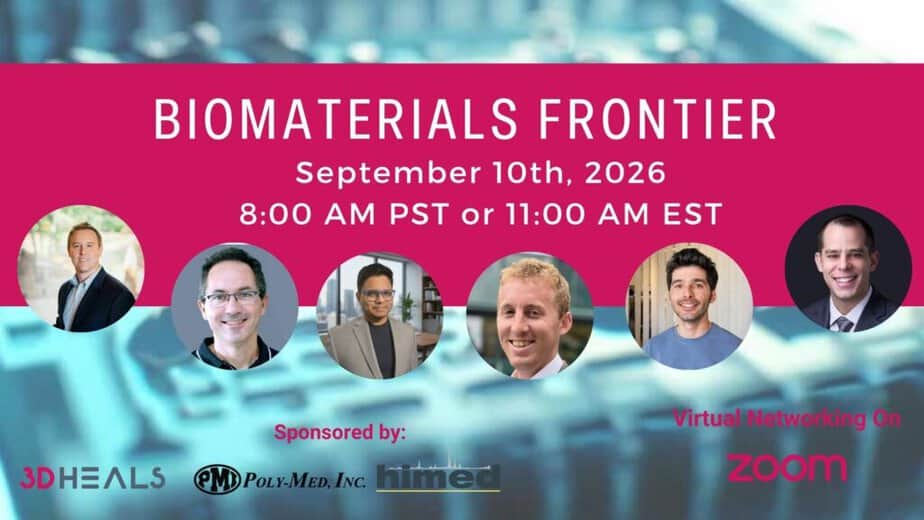
The defining shift of 2026 is from printing structure to printing function, and from lab-stage novelty toward standardized, regulator-legible material systems. Biomaterials is moving from a printable-hydrogel or metal powder afterthought to the regulated, functional, investment-grade core of 3D-printed medicine across soft (function-first bioresins), hard (ion-releasing ceramics and bioactive glass), and structural (titanium and titanium-tantalum lattices) tracks at once. Biomaterials Frontier convenes the researchers, founders, and industry leaders defining that shift.
Subscribe here to receive event emails.
Apply to speak or sponsor the event: info@3dheals.com
Speakers:
Scott Taylor, PhD

Dr. Scott Taylor is Director of Product Engineering at Poly-Med and specializes in material selection and medical device design. He has worked on development teams for more than twenty marketed medical devices and is experienced in the creation of novel materials and processes, product design and development, advanced manufacturing services, application and development of intellectual property, as well as physical and chemical testing protocols.
His 10-year involvement with ASTM includes the development and maintenance of standards within committees F04 (Medical and Surgical Materials and Devices) and F42 (Additive Manufacturing Technologies), including chairing the joint group for absorbable polymeric materials and test methods.
Dr. Taylor has undergraduate degrees in physics and mechanical engineering from Furman University and Clemson University, respectively, and completed his doctorate in Bioengineering from Clemson University. Through his tenure, Dr. Taylor has published numerous papers and conference abstracts, several book chapters, and is inventor for more than 25 US and international patents. In addition to his position at Poly-Med, he maintains an appointment as adjunct faculty of Bioengineering at Clemson University.
Fabian Trumper
Fabian Trumper is the Co-Founder and CEO of Arrakis Bio, an Israeli biotech company revolutionizing the field of regenerative human biomaterials with its True Human Collagen™, the best biomaterial for regenerative medical and aesthetics applications, bio-manufactured using cultivated human dermal fibroblasts in an industrially scalable process. He is a 3X founder, with over two decades of product, technology, and business leadership across deep tech and life sciences, including as VP of Products and Co-Founder at LightBits Labs and CEO and Co-Founder at Bountica. Fabian holds an MBA in Marketing Strategy from INSEAD.
Prof. Kamal Choudhary
Kamal Choudhary is an Assistant Professor in the Department of Materials Science and Engineering, with a joint appointment in Electrical and Computer Engineering at Johns Hopkins University. He is an elected fellow of the American Physical Society. His research focuses on atomistic materials design using classical mechanics, quantum mechanics, and machine learning methods to accelerate experimental discovery. He earned his Ph.D. in Materials Science and Engineering from the University of Florida in 2015 and previously served as a Staff Scientist at the National Institute of Standards and Technology (NIST). He is the creator of the widely used JARVIS , AtomGPT.org and the ChatGPT Material Explorer infrastructures for materials design with over 200000 users wordlwide. He has published over 100 peer-reviewed articles, with over 10000 citations. He serves as an associate editor for Nature: npj Computational Materials, and is an editorial board member of Materials Today Communications, PRX Energy, and Machine Learning: Science and Technology journals.
Andrew C. Weems
Resilient founder and CEO Dr Andrew Weems (PhD) is a former assistant professor at Ohio University specializing in medical devices, degradable polymers, photopolymers, and biomedical engineering. He is a senior member of the National Academy of Inventors, he previously founded the UK company 4D Medicine Ltd, developing photopolymer resins, and he has worked on Class 1, 2 and 3 medical devices. At Resilient Medical, Weems has multiple patents related to tissue scaffolding devices and has led the commercialization efforts of the Bravo device platform, including regulatory strategy development, fundraising, and product development.
Ebrahim Yarali
Ebrahim Yarali is a postdoctoral researcher at the Institute for Technology-Inspired Regenerative Medicine (MERLN), Maastricht University. His multi-disciplinary research focuses on developing acoustic-responsive 3D architected biomaterials that promote skeletal regeneration by guiding both chondrogenic and osteogenic differentiation of stem cells. By integrating advanced mechanical modeling, acoustic wave stimulation, and cutting-edge biofabrication techniques, he aims to address major healthcare challenges, particularly osteoarthritis as one of the most common musculoskeletal diseases.
He earned his PhD from the Departments of Biomechanical Engineering and Precision and Microsystems Engineering at Delft University of Technology (TU Delft) and holds M.Sc. and B.Sc. degrees in Mechanical Engineering. His prior work has focused on the mechanobiology of bone-cell-laden architected biomaterials, stimuli-responsive (smart) materials, 4D printing, and micro-additive manufacturing. With around 20 peer-reviewed publications in leading journals, such as Nature Communications and Advanced Materials, he aims to translate stimuli-responsive architected biomaterials into clinical applications through multidisciplinary approaches that advance tissue engineering.
Moderator:
Craig Rosenblum
Craig Rosenblum is President of Himed, LLC, a global leader in calcium phosphate biomaterials with over 35 years of innovation in plasma spray coatings and surface treatments for medical and dental devices. He collaborates with manufacturers worldwide to deliver advanced biomaterial solutions and has led interdisciplinary teams to drive the company’s growth and industry leadership. Craig discovered a unique application for post-processing of additively manufactured medical devices using Himed’s proprietary and biocompatible resorbable blast media. Himed has established the Bioceramics Center of ExcellenceTM to develop new bioceramic bioinks and rapid prototyping of next-generation medical implant designs.
Craig holds both a BS and MS in Materials Science & Engineering (Biomaterials) from The Johns Hopkins University. His groundbreaking research explored the variations in the microstructure and mechanical properties of dental enamel, first demonstrating its unique heterogeneous nature. Craig remains active with Johns Hopkins as a member of the Materials Science & Engineering Advisory Committee.
Event Sponsors:
Comments