


Graham Craig is Chief Commercial Officer at VoxCell, a Canadian biotechnology company developing high-resolution, vascularized 3D tissue models as New Approach Methodologies (NAMs) for drug development. He leads VoxCell’s commercial strategy, global business development, and strategic partnerships, working to put more human-relevant preclinical models into the hands of pharmaceutical companies, CROs, and research institutions, so teams can generate decision-enabling data earlier and reduce reliance on traditional animal testing.
Graham brings more than 18 years of experience in commercialization and strategic partnerships across the pharmaceutical and biotech sectors. Before joining VoxCell he was Director of Corporate Development at AbCellera and held senior roles at STEMCELL Technologies. Earlier in his career he spent seven years as a commercial strategy consultant at IQVIA, advising pharmaceutical companies across Europe, Asia, and North America.
When was the first encounter you had with 3D printing? What was that experience like? What were you thinking at that moment?
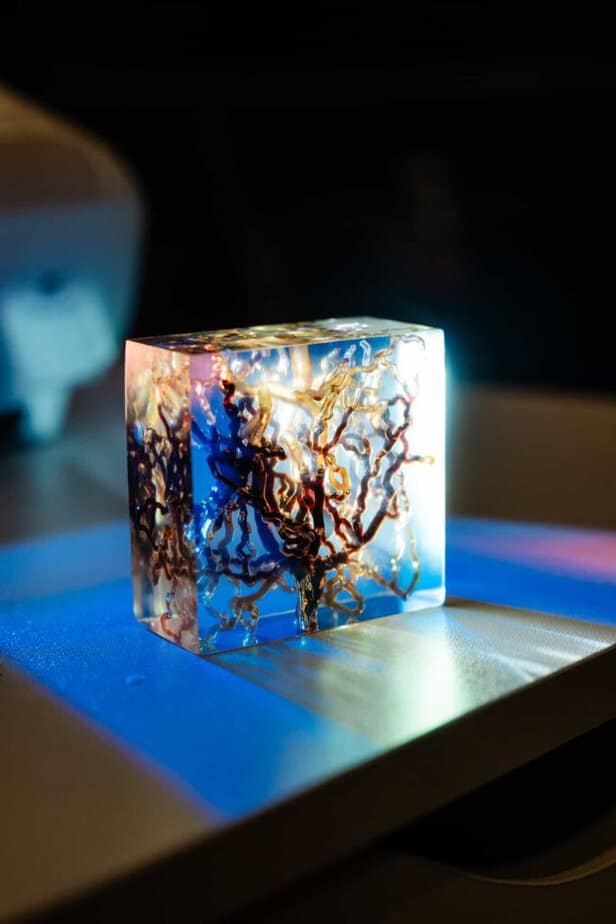
Graham: Like a lot of people, my first brush with 3D printing was seeing it as a neat gadget that my friend had. Watching his printer build a plastic F1 car layer by layer and thinking it was pretty clever. The moment that actually stuck with me came much later, when I first saw a bioprinter at work at VoxCell. Instead of plastic, it was polymerizing bioink, building a piece of tissue with an actual vascular network running through it. That reframed the whole thing for me. This was a way to recreate human biology outside the body, and I immediately started thinking about how that could help preclinical drug development.
What inspired you to start your journey/company/career/research in 3D printing (bio-fabrication/bio-printing)?
Graham: My professional background is commercial rather than at the bench. I’ve spent close to two decades helping pharma and biotech companies bring science to market, at IQVIA, STEMCELL Technologies and AbCellera. Through that period I saw two persistent and frustrating patterns: the struggle with building confidence that a preclinical drug might work in humans, and the subsequent “leap of faith” into clinical trials that often ended in failure. When I came across high-resolution bioprinting and the broader New Approach Methodologies movement, it was the first time I saw a credible, commercially viable path to generating human-relevant data early, before hundreds of millions of dollars and years of work are already on the line. Joining VoxCell was a chance to help move that from a promising idea into something the industry actually adopts.
Who inspired you the most along this journey in 3D printing (bio-printing/bio-fabrication)? This can be a mentor, a patient, a celebrity, anyone basically. You can name more than one as well.
Graham: Two people stand out. Dr. Karolina Valente, VoxCell’s founder and CEO, is my biggest influence on the bioprinting side, she built Canada’s first high-resolution 3D bioprinter and has been relentless about solving the vascularization problem many in the field thought was too hard. The other is Dr. Vassilis Lefkaditis, a decision science expert who mentored me early in my career and taught me the value of structure and data in decision-making processes – a discipline that has had a tremendous impact on my career and shaped how I think about problems and opportunities commercially.
What motivates you the most for your work?
Graham: Two things, really. The first is impact on patients; if human-relevant models can help even a handful of good drugs survive to approval that would otherwise have failed, or spare patients from therapies that were never going to work, that’s enormously motivating. The second is the commercial challenge itself. I’m energized by the work of shifting an entire, understandably conservative industry toward a new way of generating evidence. Changing how an industry makes decisions is hard, and I find that genuinely exciting.
What is/are the biggest obstacle(s) in your line of work? If you have conquered them, what were your solutions?
Graham: The biggest obstacle on the commercial side isn’t the technology, it’s inertia. Drug development workflows, regulatory expectations and decades of institutional habit are all built around animal models and it’s a complicated network of internal stakeholders within each player. Even when a human-relevant model is clearly better, buyers reasonably ask whether it’s validated, reproducible and defensible to a regulator. Our answer has been to compete on evidence: generate rigorous, comparative validation data, lean into the growing regulatory momentum behind NAMs (the FDA Modernization Act 2.0 is a good example) and build partnerships, like our collaboration with adMare BioInnovations, that let partners test the models against real programs and de-risk adoption for the rest of the market.
What do you think is (are) the biggest challenge(s) in 3D Printing/bio-printing? What do you think the potential solution(s) is (are)?
Graham: I am biased of course, but for bioprinting specifically, vascularization is still the central technical challenge. Without a functioning network of vessels you can’t keep complex tissue alive long enough for a meaningful experimental window, and you miss the very structure a drug needs to navigate in order to reach its target. That’s exactly the problem VoxCell was built to solve. Beyond that, the field has to crack reproducibility and standardization, so a model printed today matches one printed next month, possibly in in another lab, along with the throughput needed for routine industrial use. And the whole space needs regulators to keep formalizing how these models are qualified and accepted. The solutions are underway on all three fronts: higher-resolution printing of vascular structures, standardized protocols, and regulatory frameworks that are finally catching up to the science.
If you are granted three wishes by a higher being, what would they be?
Graham: I’m going to assume world peace, lottery numbers in advance and the ability to fly are all off the table. So, more realistically, given this is an industry interview: health and time with the people I love; the big industry players finally taking their own “leap of faith” with NAMs; and animal testing becoming the exception rather than the norm.
What advice would you give to a smart driven college student in the “real world”? What bad advices you heard should they ignore?
Graham: Get comfortable working at the edges between disciplines. Some of the most successful people I’ve worked with aren’t the deepest specialists, they’re the ones who can weave between the science and the market, or between the lab and the clinic, and translate. Build real relationships, stay curious outside your lane, and protect your optionality early rather than over-committing to a rigid plan. The advice I’d ignore is the pressure to map out a long-term career path and get married to “where you see yourself in five years’ time”. The most interesting opportunities I’ve had weren’t on any plan I could have written at 22, they came from being prepared and saying yes when something unexpected showed up. Seek good advisors and pay it forward later.
What’s your favorite book you read this year and why? Alternatively, what’s your favorite book of all times you read and why?
Graham: Earlier this year I read An Elegant Defense by Matt Richtel, which tells the science of the immune system through four real patients’ stories. It takes something as intricate as immunology and makes it gripping and human. It resonated professionally as well, much of modern drug development now centres on immuno-based therapies, which we’ve been testing using the models we build at VoxCell. We’re very excited to show the pain points we can address for translational teams working on such novel therapies.
Related Links:
Episode #98 | Meeting the Bioprinting Vascular Challenge: VoxCell CEO Dr. Karolina Valente
Episode 122: New Approach Methodologies (NAMs) with Dr. Lowry Curley
Event Recap: The 3D Bioprinting Frontier
Comments