

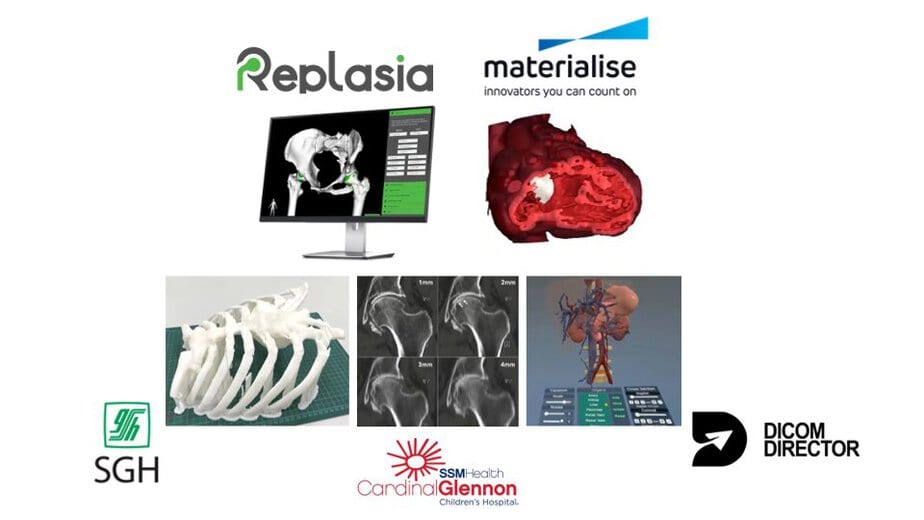
To create and build in 3D is to understand our world with greater complexity and richness. Over the years, 3D printing and visualization have captivated us and the imaginations of innovators worldwide. We have seen many incredible applications of this technology, but what brings these discussions to life are the people creating and being impacted by these changes. At our latest 3DHEALS event on Advancing 3D Surgical Planning, one of the field’s biggest challenges is realizing the entire clinical workflow. At that level, integrating 3D technologies isn’t just about the tools and gadgets – it’s also about the people who work in and depend on the clinical system. In this recap article, we’ll take a look at the main lessons we learned from our five expert panelists on how to actually put 3D into practice.
Building with Human-Centered Design
As AI takes its turn as a flashy marketing tactic, it will be important for innovators to build software with the thoughtfulness and attention to detail needed to bring actual value to users. For Dr. Tim Van Cleynenbreugel, Co-Founder and CTO of Replasia, creating a software tool to work alongside the company’s 3D-printed titanium implant for hip dysplasia presented an opportunity to develop patient-specific products in a reproducible, scalable way.
The software, called HipStudio, enables users to conveniently perform anatomic measurements, perform simulations, and compare with healthy reference data. By designing software tools that support the creation and use of their 3D-printed implant, they can make this level of patient customization more accessible and easier for healthcare providers to adopt.
This type of software can ultimately help to lower the time, cost, and effort barriers that patient-specific devices typically present. However, they must be carefully designed with the human user in mind. What repetitive steps can the software perform, and when will the user want to manually intervene? What data should we show the user, and, importantly, what should be kept hidden to avoid information overload? How much responsibility should we place on users to catch errors, especially AI-generated ones?
While the 3D printing field is working to advance software integration into clinical workflows, addressing these critical questions distinguishes practical software from hype-driven, extraneous features.
Balancing Creativity and Reproducibility
Dr. Beatriz Dominguez Gonzalez, Global Market Manager for Materialise, recommends seeing beyond the print when figuring out how to turn 3D technologies into a routine, rather than a niche, practice. She suggests investing in a workflow that (1) selects the most complex cases that will provide significant and not just marginal benefits, (2) utilizes standardized segmentation protocols, and (3) ensures that 3D plans are aligned with the surgical schedule and not the other way around.
Incorporating 3D workflows into the clinical environment will require innovators to carefully consider design standardizations and constraints, without sacrificing the flexibility the technology promises. Not every hospital will have its own 3D expert with decades of experience, which means the restrictions we place on data quality, the sequence of steps, and the double-checks that must occur are integral parts of the product.
Innovation in this field will come from technologies that empower users to be creative and express their design ideas while simultaneously adhering to strict principles that prevent them from getting lost in the software’s complexity or from ending up with undesirable results.
Listening to an Ecosystem of People
For Dr. Mark Tan, a Radiologist and Clinical Lead of the Singapore General Hospital 3D Printing Centre, bringing people together is his craft. Dr. Tan describes the importance of creating diverse teams of engineers, radiographers, managers, and clinical leads to make the technology accessible to patients and providers.
He describes several challenges in implementing 3D technologies in clinical settings. For example, creating 3D models for surgical planning involves acquiring high-quality medical imaging scans and potentially combining imaging modalities to capture the relevant spatial and temporal details. It also means having someone with computer-aided design (CAD) expertise and a person with an understanding of different printing materials.
3D planning and printing affect an entire ecosystem of individuals within the healthcare system, and innovators must anticipate how their product will affect each one of these people. Listening to their needs and preferences is what ultimately shapes a product. The customer isn’t just the patient or the surgeon; it’s also all the individuals the product depends on to get it to the end user.
Sharing the 3D Mindset
Rashi Gupta, a 3D Printing Engineer at SSM Health Cardinal Glennon Children’s Hospital, points out three major obstacles: (1) there can be a disconnect between doctors and engineers due to differences in terminology and knowledge, (2) sometimes people are unaware that the 3D lab exists, and (3) there is resistance to reimbursement for surgical planning since such plans aren’t physical products.
One way Gupta addresses these challenges is by knowing how to educate people on 3D technologies and bridging the language gap between different specialists. By taking the time to learn more about the clinical perspective as an engineer, she describes how she has a better understanding of how to bring people together around this technology and how we can better train future leaders in the field.
Innovators will need to consider how their product also requires an educational component to help stakeholders understand the device’s significance and how to use it. 3D technologies are rapidly expanding to a point where an interdisciplinary background is needed to understand the “3D mindset.” Translating innovation into a language that people from different fields can resonate with is part of the equation for user adoption.
Bringing Real Value to Clinicians
One of the major goals of Dr. David Pearlstone, CEO of DICOM Director, is to achieve a human digital twin that will allow clinicians, patients, and families to understand a person’s specific medical condition through computer simulations and visualizations. For Dr. Pearlstone, the predictive ability of such twins will enable greater insights and benefits, such as understanding how a tumor mass will grow over time.
While AI may play a significant role in the future of predictive digital twins, it will be up to humans to decide which predictions will be useful in clinical practice and which are just noise. Predictions may provide more information to the clinician, but many will shrug their shoulders as to what it means if there isn’t good evidence to back it up.
Dr. Pearlstone envisions a future in which digital twins improve clinicians’ practice of healthcare through predictive insights, and it will be important for 3D specialists to decide how those predictions fit into the overall clinical workflow.
Continue to Explore with Us
This event has shown us that while 3D technologies for surgical planning are here, their integration into the clinical workflow still has many unsolved hurdles. Through our expert panelists, we are beginning to understand what this integration might look like and the ways the field can actually fulfill the promises it makes. Continue to explore with us on this journey by registering for our live webinars and subscribing to our newsletter.
About the Author:
Peter Hsu

Peter Hsu is an editorial intern for 3DHEALS. He is currently an undergraduate at the University of Illinois Urbana-Champaign and studies bioengineering with a focus on cell and tissue engineering. He is also minoring in computer science with interests in artificial intelligence and image processing. Peter conducts research on using computer vision methods to analyze human tissue images and improve the robustness of machine learning workflows. He is interested in the use of AI to assist tissue engineering and bioprinting research for medical applications. He is passionate about science communication and leads STEM outreach lessons at schools in the central Illinois area.
Related Links:
Communicating Your Science in the Bioprinting Space
Event Recap: 3D-Printed Devices In Orthopedics
Event Recap: Microfluidic Devices and 3D Printing
Expert Corner: AI in Healthcare 3D Printing: The Future is Now
Comments