

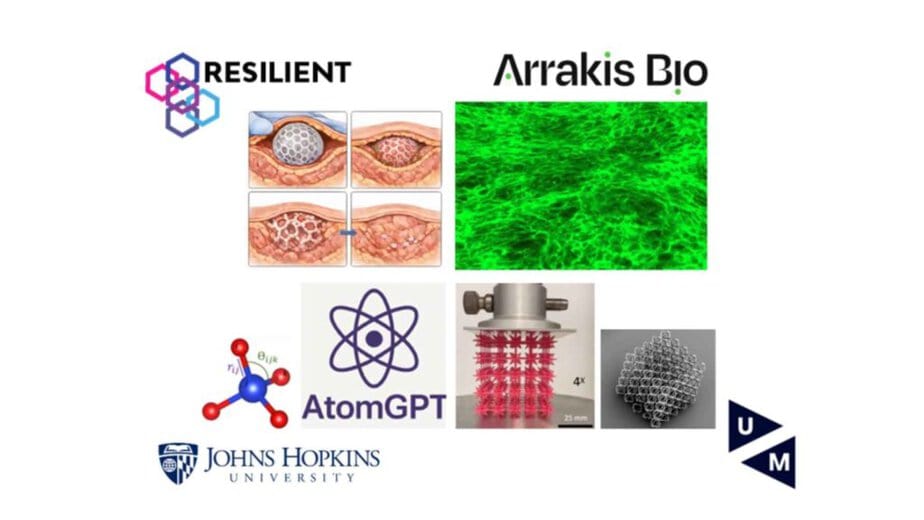
What makes our events so exciting to me is that we get to answer the question: What does it mean to create? I think it’s one of the most fundamental questions that 3D printing enthusiasts have the opportunity to face. A print bed is an empty canvas like no other, ready for a creation that is meant to be touched by human hands, used in our daily lives, and tested to the extremes. For those in the medical field, that creation goes a step further to becoming an integral part of the human body and helping to live with greater longevity and vigor. How do we create something that carries so much responsibility? How do we build with intention and care? To begin to think about these challenges, we turn to our recent 3DHEALS event on the Biomaterials Frontier, where we learned from creators pioneering the future of absorbable implants, computational design, and biomaterials manufacturing.
Discovering the world through design
Dr. Ebrahim Yarali, a Postdoctoral Researcher at Maastricht University, uses 2D unit cells to create intricate 3D structures that can be used as cellular scaffolds. These “unit cells” are simple 2D shapes that can be repeated into a 3D lattice-like structure. Using a computational approach, they can design unit cells and their corresponding 3D forms with predicted mechanical properties. They can then be fabricated using two-photon polymerization, a light-based 3D printing method for creating ultra-small objects.
To test the designs, they grew preosteoblasts on the scaffolds. Preosteoblasts are cells found in humans and other animals that eventually become the cells that create bone. While bone cells are known to “feel” the structure of their surroundings and respond accordingly, the exact mechanisms and environments needed to produce certain responses aren’t entirely clear. Dr. Yarali found that cells on scaffolds with positive Poisson’s ratios had higher metabolic activity than those with negative Poisson’s ratios. These “architected biomaterials” can ultimately help us to one day grow artificial bone with just the right properties that properly repair injuries.
What’s fascinating about Dr. Yarali’s work is his attention to the fundamental building blocks of design. By crafting simple 2D shapes and lines into repeating patterns, Dr. Yarali is able to form mesmerizing 3D architectures that are able to interact with and influence life itself. Through this appreciation of basic design principles, we can begin to better understand the complex nature of biology, exploring its mysteries with careful attention to fine-grained, low-level details. That’s a valuable counterpoint as we enter an age that increasingly prioritizes fast-paced, high-level design.
Creating AI that actually helps people
Dr. Kamal Choudhary, an Assistant Professor at Johns Hopkins University, focuses on creating AI software for materials research. Dr. Choudhary developed JARVIS, a highly extensive collection of public datasets and tools for materials design. The project includes JARVIS-DFT, a database of materials with computed properties that can be used to quickly identify materials of interest. There’s also JARVIS-ALIGNN, an AI model designed to use atomic distances and bond angles to predict a variety of properties, including a material’s stability and whether it is a conductor, semiconductor, or insulator.
Recently, Dr. Choudhary created his own version of ChatGPT aimed to answering materials science questions by leveraging domain-specific databases to address the need for more accurate language models. Taking AI even further, he has created AtomGPT, a platform that consists of AI “agents” that determine when and how to use different external materials science databases and tools to solve a user’s task.
Central to Dr. Choudhary’s work is an emphasis on building tools that actually help people discover and learn in a more enriching way. Careful design choices about what data and evidence influence the models, how the user interacts with the platform, and how to properly validate the results are key to creating with thoughtfulness and intention. In making these choices, the human becomes a beneficiary of this technology, not just a means to pursue greater AI adoption in scientific fields.
When we put the needs of people and communities first, we can begin to realize better ways to build domain-specific AI and technology. That’s even more important as we progress towards one day achieving an AtomGPT that is biologically aligned, with knowledge of biocompatibility and medically relevant materials. Discoveries that affect human health could one day depend on such technology, and we must create knowing who we are ultimately impacting.
Bringing accessibility into the equation
Dr. Andrew Weems, Founder and CEO of Resilient Medical Corp, is working on commercializing the Bravo device, a 3D-printed polyester scaffold that is implanted into the empty space following the removal of a lump in breast cancer surgery. The scaffold helps by providing support for breast tissue to grow in that space, improving the recovery process and cosmetic outcomes.
Dr. Weems talked about how they previously explored thiol-epoxy foams and 3D-printed photopolymers as potential biomaterials for their scaffold. However, they ultimately pivoted away from these more experimental methods due to the regulatory challenges of getting such novel materials approved. Instead, they strategically selected commercial, off-the-shelf polyester that is FDM-printed with a clearer regulatory pathway. This means that they can more easily fit within the traditional surgical workflow rather than presenting barriers.
Accessibility is a cornerstone of what it means to create. When we create, we decide how others will access our ideas. Turning our thoughts into tangible, physical prints lets us to share our care and attention with the people who receive them. Accessibility is far-reaching: it includes timely availability, usability in a variety of environments, and access to relevant, understandable information. Innovation and accessibility go hand in hand, and it is our responsibility to ensure accessibility is intentionally built into everything we create.
Designing a process for the future
Fabian Trumper, Co-Founder and CEO of Arrakis Bio, is advancing the next generation of biomaterials by manufacturing collagen derived from human cells. By using human cells instead of other animals or bacteria, they can produce collagen with properties we would want in a human-relevant model, potentially providing better insights into human biology and disease.
A key consideration for Trumper is making human collagen at industrial scale and cost, which will be necessary to meet the demands of bioprinting companies and research. By using cells that produce 50x more collagen than untreated cells, Trumper is building the manufacturing processes needed to bring human collagen biomaterials to life.
When we create, the process matters. Ultimately, the process becomes part of the product itself and matters as much as the end goal. When we think about the process, we’re figuring out how to make our creations sustainable in the long-run. How exactly do we create this so that we can keep creating it 10, 50 years down the line? It isn’t just a question of efficiency and scalability; it’s also about ethics, quality, and societal responsibility. Producing collagen with donated human cells helps us move away from animals in research and has the potential to improve the quality of research and products for patients.
Join us live at our future events
It’s exciting to see how these biomaterial innovators are creating the future of healthcare 3D printing. We are continuing to see impressive strides in biomaterials year after year. To catch up on what we’ve seen in the past, check out 3DHEALS articles featuring our sponsors, Dr. Scott Taylor from Poly-Med and Craig Rosenblum from Himed. Stay up to date on the latest in biomaterials by subscribing to the 3DHEALS newsletter and joining our future events live.
About the Author:
Peter Hsu

Peter Hsu is an editorial intern for 3DHEALS. He is currently an undergraduate at the University of Illinois Urbana-Champaign and studies bioengineering with a focus on cell and tissue engineering. He is also minoring in computer science with interests in artificial intelligence and image processing. Peter conducts research on using computer vision methods to analyze human tissue images and improve the robustness of machine learning workflows. He is interested in the use of AI to assist tissue engineering and bioprinting research for medical applications. He is passionate about science communication and leads STEM outreach lessons at schools in the central Illinois area.
Related Links:
Event Recap: New Approach Methodologies (NAMs)
Event Recap: Advancing 3D Surgical Planning
Communicating Your Science in the Bioprinting Space
Event Recap: 3D-Printed Devices In Orthopedics
Event Recap: Microfluidic Devices and 3D Printing
Expert Corner: AI in Healthcare 3D Printing: The Future is Now
Comments