

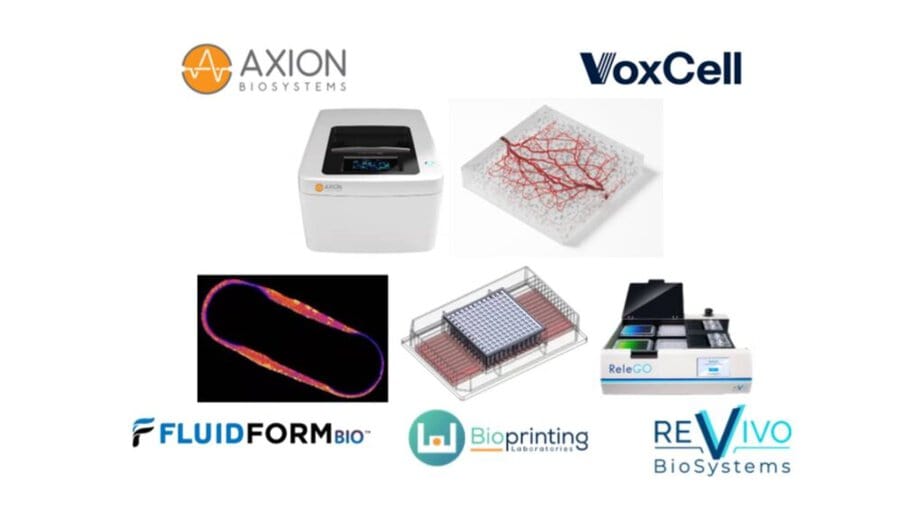
In our recent 3DHEALS event, we dug deep into the world of New Approach Methodologies (NAMs), which describes any strategy for testing new medicines that replaces traditional animal testing. NAMs are particularly important to healthcare 3D printing enthusiasts, as they represent a burgeoning opportunity for bioprinted tissues and organ-on-a-chip platforms to reach close-term commercial success and dramatically change the regulatory landscape. The United States Food and Drug Administration’s shift away from animal testing in favor of more ethical and convincing alternatives is opening doors for innovators, but it is certainly not without its challenges. What exactly is a NAM? Will it actually lead to reduced costs and safer outcomes? Or will the allure of new technologies fool us into believing false promises? In this recap article, we’ll highlight the latest in NAMs from our event’s five expert industry panelists.
What are New Approach Methodologies (NAMs)?
New Approach Methodologies (NAMs) broadly encompass organ-on-a-chip devices, bioprinted cells/tissues, and computational simulations (notably, artificial intelligence) to test the safety of new therapeutics. While one of the main motivators is to reduce animal testing for ethical reasons, there is strong interest in identifying NAMs that better model human responses to novel medications. After all, a mouse isn’t a human, and it certainly isn’t easy (nor cheap) to raise mice.
Dr. Mike Clements, Senior Vice President for Scientific Partnerships and Strategy at Axion BioSystems, described how this regulatory shift increases flexibility in how evidence can be acquired but that the scientific bar hasn’t changed: the new test still needs to be relevant, reproducible, and appropriate. While such a change sounds nice in principle, it opens up a plethora of complications. Flexibility begets variability and ambiguity, which is quite the opposite of what we would want in a pre-clinical test.
Dr. Clements stressed the importance of standardization as one way to advance NAMs. For studies involving human-derived induced pluripotent stem cells (iPSCs), standardization means identifying the key environmental variables that influence downstream results, such as cell culture temperature and density, and then defining practical acceptance criteria to ensure these variables don’t compromise the integrity of the test. By taking such steps to increase reproducibility, we are on our path to seeing new cell culture-based NAMs become a regulatory standard.
Unfortunately, NAMs aren’t going to make things easier any time soon; rather, it’s only the beginning of a new host of challenges. Standardization isn’t cheap: dedicated professionals will still have to run or supervise a number of quality control tests to ensure that these novel models work as intended. And while we don’t need highly complex models that capture everything about the human body, we risk settling on models that unintentionally oversimplify certain biological conditions due to technological or knowledge limitations.
Where do NAMs create value?
Graham Craig, Chief Commercial Officer at VoxCell, explained that the value of NAMs lies in their ability to answer human-relevant questions earlier in the drug development process, rather than waiting for clinical trials to reveal critical safety results. By tackling such questions earlier, companies may be able to discover safe and effective drugs faster and at lower cost.
Craig described how there are four decision categories where NAMs can provide improvements: (1) target engagement, (2) functional efficacy, (3) liability identification, and (4) exposure and tissue interaction. In other words, NAMs can provide new insights into whether the drug binds in a human-relevant context, its downstream biological effects, potential side effects, and its ability to localize to the target tissue site. These decision categories enable us to pinpoint the problem the NAM seeks to address and evaluate whether it is well suited to that purpose, rather than chasing the unrealistic goal of crafting a broad NAM that captures everything about human biology.
While NAMs are well-positioned to bring about improved insights in these decision categories, at the end of the day, they are still just models, representations of reality with limitations governed by our assumptions. For example, artificial intelligence (AI) and other computational NAMs (in silico models) can enable rapid drug testing through simulations trained on real-world data. However, such improvements cannot come to fruition if these computational models are fraught with biases from the data collection process, or if these AI models are constructed as black boxes without any way to explain their predictions.
NAMs present an exciting opportunity, but we must still be mindful to acknowledge and address their limitations. An understanding of how such limitations affect our conclusions and how they might help us design further tests to address those limitations is just as important as the results themselves.
What are current examples of NAMs?
FluidForm Bio is using its FRESH bioprinting technique to create remarkable tissue constructs for use as NAMs. Dr. Andrew Lee, the company’s Co-Founder and Senior Scientist, shared how their cardiac drug discovery platform involves using human cells and extracellular matrix, creating a computational design of the tissue architecture, performing robotic biofabrication of human tissue, and finally measuring the 3D tissue.
By using bioprinting, they are able to create a variety of tissue shapes, including rings, strips, bands, and 3D ventricular structures, that are capable of beating like the heart. As a result, they are able to measure the spatial, not just temporal, behavior of the tissues. In one use case, they can induce arrhythmia in their bioprinted tissues and show a restoration of normal function using a typical lidocaine treatment. They can also structurally mimic cardiac disease states by computationally designing and fabricating fibrotic tissue.
Another interesting avenue for NAMs is tissue-on-a-chip devices. Alexandre Civiere, Sales and Business Manager at REVIVO BioSystems, showed us the company’s microfluidics platform, which consists of skin tissue and collagen made from human primary cells. This tissue is then placed inside an automated, programmable microfluidic device that continuously pumps a liquid in contact with it. By having this continuous flow, they can collect biomarkers released by the tissue over time for longitudinal studies.
Civiere explained that they can also create a wound in the epidermis and measure changes in the pro-inflammatory marker interleukin-6 (IL-6) over time, with IL-6 expected to decrease as the wound closes. Interestingly, they measure tissue permeability using caffeine to assess recovery of the skin’s barrier properties, since caffeine permeability should decrease as the skin regrows. Ultimately, one could use this model to test the behavior of different drugs in a reproducible, high-throughput setting.
While NAMs might be seen as just another umbrella term to describe recent advancements in tissue models, they are actually an important reminder that regulatory and reproducibility considerations must occur early in the design process. Technologies such as bioprinting may enable companies to create highly customized, engineered solutions for clients, but companies interested in influencing the NAMs field must understand how these bespoke choices would fare in a regulatory context. And the innovators who are currently thinking about NAMs have the potential to greatly impact the future of drug development: as Civiere mentioned, they’re effectively contributing to the creation of a new standard when the standard doesn’t already exist.
Where is the future of NAMs heading?
Dr. Pranav Joshi, Senior Scientist at Bioprinting Laboratories Inc., shared that customers told them the real burden was in the preparation process. Addressing this operational burden would help transform models from promising organoids to assay-ready NAMs. To achieve this, quality control and automation can make NAMs more efficient and less error-prone. In particular, Dr. Joshi says that quality control needs to be distributed throughout the organoid lifecycle, with each QC gate having predefined acceptance criteria and clear corrective action.
The future of NAMs, therefore, lies in streamlining, automating, and validating rigorous quality control processes for novel assays. Integrating these considerations into a product has far-reaching benefits by pushing the industry towards greater standardization and reproducibility, increasing assay reliability for customers, and actively shaping the future of regulation.
Join us for future events
As we have seen from our five expert panelists, the NAMs’ perspective is essential when thinking about the latest advancements in bioprinting, organ-on-a-chip, and AI technologies. NAMs call to our attention the need for fit-for-purpose models, as well as the need for a thorough consideration of a new assay’s complexity, limitations, biases, and cost. If we aren’t careful, these issues will overshadow the benefits that cutting-edge innovations promise. We invite you to continue exploring new perspectives in healthcare 3D printing with us by subscribing to the 3DHEALS newsletter and our YouTube channel. To watch the full event you can also check out our on-demand archive here.
@3dheals Organ Chip Workflows_ Overcoming the Biggest Caveats Moderator Dr. Lowry Curley challenges speakers on why NAMs have not entered into #pharma workflow more routinely for #drugdiscovery #CiPA #FDA #iPSC #Toxicity Check out our latest event recap with video highlights: https://3dheals.com/event-recap-new-approach-methodologies-nams/ Full event on demand: https://3dheals.com/courses/new-approach-methodologies-from-theory-to-validation/ #NewApproachMethodologies #DrugDiscovery
♬ original sound 3dheals
About the Author:
Peter Hsu

Peter Hsu is an editorial intern for 3DHEALS. He is currently an undergraduate at the University of Illinois Urbana-Champaign and studies bioengineering with a focus on cell and tissue engineering. He is also minoring in computer science with interests in artificial intelligence and image processing. Peter conducts research on using computer vision methods to analyze human tissue images and improve the robustness of machine learning workflows. He is interested in the use of AI to assist tissue engineering and bioprinting research for medical applications. He is passionate about science communication and leads STEM outreach lessons at schools in the central Illinois area.
Related Links:
Event Recap: Advancing 3D Surgical Planning
Communicating Your Science in the Bioprinting Space
Event Recap: 3D-Printed Devices In Orthopedics
Event Recap: Microfluidic Devices and 3D Printing
Expert Corner: AI in Healthcare 3D Printing: The Future is Now
Comments