

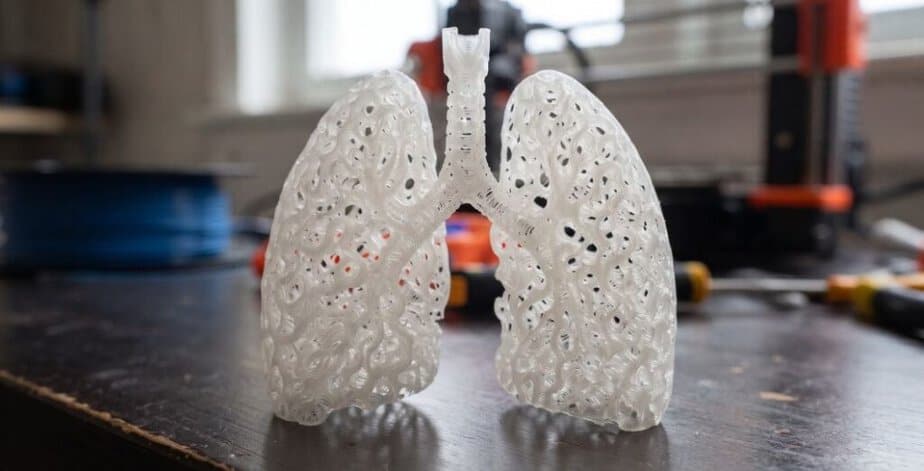

A 3D-printed implant can pass every inspection and still fail an audit. The part may be fine. Nobody can say whether the next one will be. That gap is the black box at the center of medical additive manufacturing, and it is getting harder to ignore as 3D printing moves from prototypes to patient-specific devices made one at a time. Two recent pieces make the case from opposite ends of the field. In Design News, Ben Wynne, CEO of printer maker Intrepid Automation, argues that to regulated buyers, “a part without a data record is simply a shape.” At the biological end, a Penn State team writing in Trends in Biotechnology argues that nondestructive testing should be built into every stage of bioprinting, because cells, bioinks, print settings and tissue maturation all vary. Different end products, same problem: we can see the part, but not how it was made.
What is an open-loop 3D printer?
An open-loop machine executes instructions without checking the result. Most printers work this way. An operator loads a recipe, and the machine applies the same exposure, speed, and wait time to every layer.
The trouble is that nothing inside a printer stays still. In resin printing, curing gives off heat, so the resin warms through a build and cures differently at layer 800 than at layer 8. Tank membranes stretch. Light sources dim with age. In metal printing, heat builds up in small features. The recipe knows none of this. Its log records what the machine was told to do, not what it did. Problems surface only at inspection, often after a whole build is lost.
This is a known pain point of using 3D printing. The endless trial-and-error process to reach a final, satisfying product.
What makes a printer closed-loop?
A closed-loop machine measures what is happening and corrects itself during the print. Wynne’s definition has three parts:
- a sensor that measures something the result depends on;
- a characterized relationship between that measurement and a setting the machine can change;
- an actuator that makes the change mid-print, without waiting for a person.
A temperature readout or an email alert is monitoring, not control. Radiologists often recognize the distinction. A CT scan at fixed tube current is open loop: every patient gets the same setting. Automatic exposure control is closed loop: the scanner measures attenuation and adjusts dose as it goes, within limits validated in advance. Nobody calls that unpredictable.
Which 3D printers on the market are closed-loop?
Fewer than the marketing suggests. Most systems sit somewhere on a spectrum:
- Fully marketed as closed-loop. Stratasys’ Origin One resin platform uses what the company calls closed-loop feedback software to control light, heat, and force, with more than 25 sensors. Intrepid Automation’s projection printers, described in Wynne’s article, adjust exposure pixel by pixel from a thermal camera and slow peeling when adhesion forces climb.
- Partly closed-loop. Formlabs’ Form 4, common in dental labs, does not market itself that way, but its heated resin tank and Z-axis force sensor each act on their own measurements. Light exposure, though, isn’t adjusted layer by layer based on sensor data.
- Mostly monitored. Most metal powder bed printers, which make the bulk of titanium implants, record melt pool and build-chamber data but do not change laser power in real time. Closed-loop laser control has been shown mainly on research machines; one group lists the closed architecture of commercial machines as a main obstacle.
The useful question to ask any vendor: does the machine change a setting by itself during the print, and does it log why?
Why does this matter for FDA-regulated devices?
FDA’s 2017 guidance on additive manufactured medical devices (our summary) already points this way. It says process validation applies where results cannot be fully verified by later inspection and testing, and that it must cover parts within a build, between builds, and between machines. It gives in-process monitoring examples such as melt pool data and build-chamber temperature, pressure, and humidity. It asks manufacturers to document machine parameters, and it lists software updates, material changes, and moving the machine as triggers for revalidation.
Patient-matched devices sharpen the point. They are made in lots of one, so you cannot pull a sample and destroy it. The process record becomes the evidence. And since February 2, 2026, the FDA has inspected device makers under its Quality Management System Regulation, built on ISO 13485, which also requires validating processes whose output cannot be fully verified.
Two gaps remain. The 2017 guidance does not address point-of-care manufacturing, or products made with cells and tissue. Those are exactly the areas growing fastest, and exactly where the Penn State authors say measurement is weakest.
Closed-loop control does not conflict with qualification. What gets frozen is the framework: the sensors, the control rules, the limits and the stop criteria. The path inside it adapts, and every adjustment is recorded. Machining settled this long ago, when CNC machines began correcting for spindle heat without anyone calling them nondeterministic.
Who owns the data?
Many printer makers ship locked process profiles and treat exposure settings as trade secrets. That leaves customers trying to qualify a process they can’t inspect. Wynne, who holds patents on adaptive control, draws a sensible line: protect the method, disclose the record. What the machine did to a specific part should belong to the part’s owner.
From process records to physical AI
A second reason the record matters is bigger than compliance. Physical AI, meaning AI that perceives and acts in the real world, runs on data from real machines. Investors are betting heavily on it; robotics software company Physical Intelligence was reported in talks at about a $20 billion valuation in late October. Manufacturing is an obvious target.
Yet additive manufacturing has little usable data to offer. “There is already a data struggle,” Synera’s Andrew Sartorelli told 3DPrint.com, noting that OEMs are reluctant to give up their IP. An open-loop printer produces a recipe and a part, nothing to learn from. A closed-loop printer produces a layer-by-layer record of conditions, corrections and outcomes for every part. Pooled across a fleet, and linked to inspection and clinical results, those records are the training set that could make printers predict defects, suggest better settings, and eventually tighten their own qualified limits.
Wynne’s rule for getting there is a good one for medicine: AI observes, classifies, and recommends; validated control rules act; and any change to the framework goes through normal change control. In my view, hospitals and device makers should start asking for open, machine-readable process records in every printer purchase now. The data you do not capture today cannot train anything tomorrow.
The bottom line
Medical 3D printing has spent a decade proving it can make the shape. The next decade is about proving how each shape was made. Printers that can show their work will be easier to validate, easier to defend in an audit, and the foundation for AI that actually understands manufacturing. Printers that cannot will stay black boxes.
Would you buy a printer that can’t tell you what it did to your part? Tell us at info@3dheals.com.
Sources
- Wynne B. “A 3D-Printed Part Without Data Is Just a Shape.” Design News, Oct 21, 2026
- “Nondestructive quality control across the life cycle of bioprinted products.” Trends in Biotechnology, 2026
- FDA. Technical Considerations for Additive Manufactured Medical Devices (Dec 5, 2017)
- FDA. Quality Management System Regulation, effective Feb 2, 2026
- Stratasys. Stratasys to Acquire Origin (Origin One closed-loop feedback software)
- Formlabs. Form 4 tech specs (sensors and control systems)
- Jiang T, Leng M, Chen X. Preheating temperature control and low-contrast imaging data analytics for LPBF (NSF PAR)
- 3DPrint.com. “RAPID 2025: Tracing the Real Progress of AI in 3D Printing” (Synera quote)
- Bloomberg. “Robotics Lab Physical Intelligence in Talks for a $20 Billion Valuation,” Oct 27, 2026
- 3DHEALS. Finalized FDA guidance “Technical Considerations for Additively Manufactured Medical Devices”
- Episode 127: Lean Compliance For Medical 3D Printing With Erik Boelen
Comments