

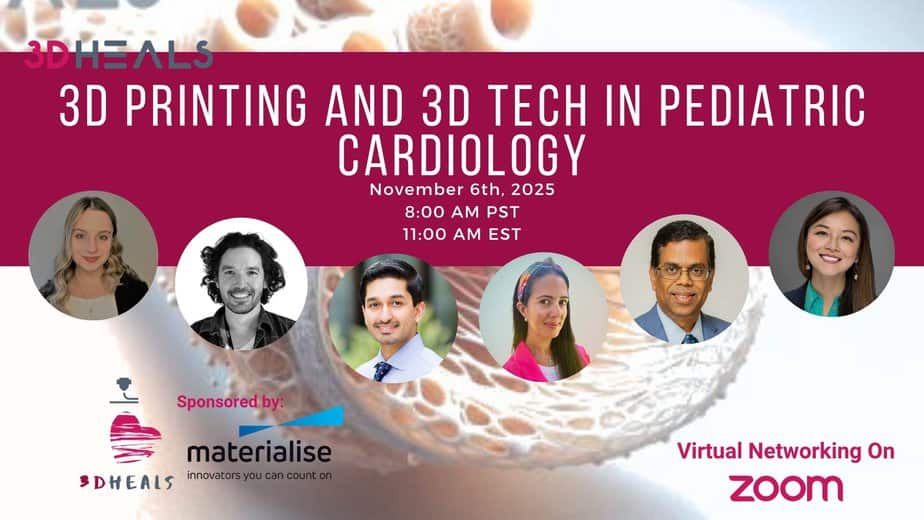
Description
3D printing and 3D imaging technologies have quickly become transformative tools in pediatric cardiology, fundamentally changing how clinicians visualize, plan, and execute treatment for congenital heart defects. Clinicians increasingly use patient-specific 3D printed models for complex procedural planning, surgical rehearsals, and team communication, which enhances understanding of intricate cardiac anatomies that are often not fully appreciated through traditional imaging alone. Examples include models that replicate individual patient hearts for preoperative planning or hands-on training, leading to increased confidence, accuracy, and reduced operating times. Recent pediatric studies published in 2020 show that over 80% of pediatric cardiologists report that 3D models are highly beneficial for surgical planning and for educating both medical teams and families about congenital heart disease. New developments, such as functional and physiological 3D models, can even predict post-surgical heart performance, further expanding their clinical value. On the market side, as the adoption of 3D technologies in pediatric cardiology rises, the global market for related services is seeing substantial growth. The 3-D printed pediatric heart model service market, for example, is forecasted to reach over $484 million by 2033 as more academic centers and hospitals incorporate these models into routine care and training. Broader estimates project the medical device 3D printing market surpassing $46 billion globally by 2033, reflecting strong growth in cardiac and vascular applications alongside orthopedics and craniofacial surgery. Despite ongoing challenges such as cost and geographical disparities in access, trends point to greater integration of 3D printing, virtual reality, and advanced simulation across pediatric cardiology programs as essential technologies for improving outcomes and patient-specific care.
Speakers:
Sarah Ptashnik

Driven by a genuine passion to make a positive impact on others, I focus on utilizing both my specialized skills and my natural ability to empathize to support those around me. Whether through leveraging technical expertise or offering thoughtful guidance, my goal is always to create meaningful, lasting change.
With a background in biomedical engineering and hands-on experience at Materialise, I’ve gained the knowledge and tools necessary to build strong, trust-based relationships with healthcare professionals. I’m dedicated to understanding their unique challenges and designing, articulating, and guiding the implementation of optimal 3D modeling solutions that advance surgical planning and ultimately improve patient outcomes. I am specifically passionate towards the pediatric cardiology space.
Nick Jacobson
Nicholas Jacobson, MDes is an architect, engineer, and scientist whose work bridges computational design, medicine, and additive manufacturing. As CTO and Principal Investigator of Tangible Vet Tech, he leads the development of MitraForm—a patient-specific, minimally invasive mitral valve repair device—advancing technologies that originated in pediatric cardiology to improve access to life-saving interventions. His research integrates multimodal imaging, voxel-based modeling, and hemocompatible 3D printing to translate precision medicine tools from human to veterinary and back again.
Previously at the University of Colorado’s Inworks Lab, Nicholas collaborated with pediatric cardiologist Dr. Gareth Morgan to create the methods for 3D-printed implants used in complex congenital heart surgeries, winning the Gates Grubstake Award. His work and research have been published in books, scholarly journals, magazines, and newspapers; these include ACADIA, AD, CAADRIA, Code LA, Huffington Post, Modern Luxury, Nature, New York Times, Popular Science, Sky News, and Vogue and shown work both nationally and internationally, reflecting his mission to fuse design and medicine into technologies that make cardiac care more precise, personal, and humane.
Dr. Shafkat Anwar
Dr. Shafkat Anwar is a pediatric cardiologist with a specialty in noninvasive imaging of the heart, including echocardiography and cardiac MRI. He is the Director of the Pediatric Heart Center’s Cardiac MRI Program at UCSF Benioff Children’s Hospital. He is also the co-Founder and Medical Director of the UCSF Center for Advanced 3D+ Technologies. His work focuses on using advanced imaging and 3-D printing in optimizing care for patients with birth defects of the heart. The technologies he studies include various types of advanced applications, including 3-D printing; and virtual, augmented or mixed reality.
He earned his medical degree at the George Washington University School of Medicine and Health Sciences. He completed a residency in pediatrics at Children’s National Health System, as well as a research fellowship at the National Institutes of Health. He also completed fellowships in pediatric cardiology and cardiac imaging at Cleveland Clinic and Children’s Hospital of Philadelphia, respectively. Prior to joining UCSF, he served as Cardiology Director of the Cardiac MRI program at Washington University in St Louis, St. Louis Children’s Hospital. At Washington University, he co-founded and co-directed the Center for 3D Printing. He is a founding member and the inaugural Chair of the Special Interest Group on advanced 3-D visualization of the Society for Cardiovascular Magnetic Resonance. He is a member of the American College of Cardiology, American Society of Echocardiography, American Heart Association, and Radiologic Society of North America.
Dr. Jenny Zablah, MD
Dr. Jenny Zablah is an Interventional Congenital Cardiologist and Associate Professor of Pediatrics at the University of Colorado School of Medicine. She serves as Director of the Pulmonary Vein Stenosis Program and leads the Advanced Imaging and 3D Innovation Program at Children’s Hospital Colorado Cardiac Catheterization Laboratory.
Her work bridges clinical innovation and translational research, integrating 3D printing, virtual and augmented reality, and computational modeling to enhance congenital heart interventions.
She has been recognized among Forbes Central America’s 100 Most Influential Women (2020) for her global contributions to medicine and science.
Ravi Ashwath
With two decades of expertise in pediatric cardiology, Dr. Ravi Ashwath stands at the forefront of advanced medical imaging and surgical innovation. As a visionary leader, he has revolutionized the field by integrating cutting-edge technologies, such as 3-D printing and virtual reality, into his practice. Dr. Ashwath’s remarkable journey has been marked by a steadfast commitment to empowering both patients and medical trainees with knowledge and understanding of complex heart diseases.
Educational Background: Dr. Ashwath earned his MBBS in India and completed his pediatric residency at Maria Fareri Children’s Hospital, New York Medical College. He subsequently completed a cardiology fellowship at Rainbow Babies and Children’s Hospital, Case Western Reserve University, where he also served as chief fellow. He trained in Cardiac MRI at Boston Children’s Hospital, Harvard University. He is Board certified in Pediatrics and Pediatric Cardiology.
Professional Accomplishments: Dr. Ashwath’s distinguished career includes serving as the Fellowship Program Director for over 15 years, mentoring and shaping the next generation of pediatric cardiologists. He is a Fellow of the American Academy of Pediatrics and an esteemed member of professional organizations, including the Society of Cardiovascular MRI and the American Society of Echocardiography. He has authored or co-authored numerous peer-reviewed papers and journal articles on topics including imaging of congenital heart diseases, use of advanced imaging techniques, clinical outcomes in various conditions, and applications of 3D printing and VR.
Innovative Contributions: Dr. Ashwath’s pioneering work revolves around advanced cardiovascular imaging, encompassing echocardiography, magnetic resonance imaging, and computed tomography. Has been a Site-PI or Principal Investigator on various funded projects, including those focused on pulmonary arterial hypertension, 3D Printing and Virtual Reality, QR Code utilization, and a novel app for teaching congenital heart diseases. His passion for innovation shines through his research, focusing on the applications of 3-D printing in intricate cardiac surgeries and leveraging virtual and augmented reality for clinical management and education.
Leadership and Recognition: In addition to his clinical achievements, Dr. Ashwath has excelled in leadership roles, having directed Cardiac Imaging programs and Pediatric Specialty Clinics. His contributions have earned him accolades such as the Outstanding Teacher Award from the Department of Pediatrics at Case Western Reserve University. He has been recognized with the Cum Laude Award for educational exhibits at RSNA and several best poster and clinical case awards at national meetings.
Current Role: Currently serving as a Professor of Pediatrics at Baylor College of Medicine and the Division Chief of Pediatric Cardiology at Christus Children’s Hospital, Dr. Ashwath continues to push the boundaries of pediatric cardiology. His administrative acumen drives the promotion of efficiency in workflow and the enhancement of systems, ultimately improving physician productivity and well-being.
Dr. Ashwath strives to be a compassionate healer, dedicated educator, and pioneering innovator, continuing to shape the future of pediatric cardiology, inspiring generations of medical professionals, and bringing hope to countless families.
Moderator:
Dr. Jenny Chen
Dr. Jenny Chen is trained as a neuroradiologist, and founder/CEO of 3DHEALS. Her main interests include next-generation education, 3D printing in the healthcare sector, automated biology, and artificial intelligence. She is an angel investor who invests in Pitch3D companies.
Reviews
There are no reviews yet.