

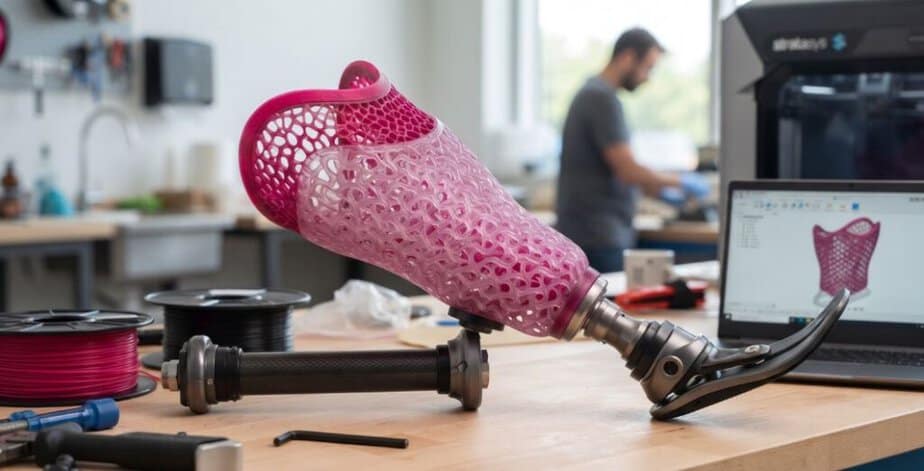

On November 12, 2026, 3DHEALS hosted its annual virtual event on 3D-printed orthotics and prosthetics (O&P). Five speakers presented the next generation of personalized devices. Jade Ward (RIT AMPrint Center) described density-graded lattice sockets and a 10–15-year plan to regrow limbs using 3D-printed biohybrid scaffolds. Tergel Bayarsaikhan (RightFit) showed how an AI-assisted design platform lets clinics in Mongolia, a country with no certified orthotists, print ankle-foot orthoses on desktop printers. Louis-Philippe Broze (Spentys) explained why only about a quarter of the O&P market has gone digital, and how clinical evidence and AI can speed up adoption. Kaiyan Qiu (Washington State University) presented a 3D-printed electronic skin that lets prosthetics sense pressure and temperature and identify materials with close to 100% accuracy. Schendy Kernizan (Rapid Liquid Print) showed mold-free silicone printing that can deliver a custom prosthetic liner the same day. The shared conclusion: 3D printers are no longer the bottleneck in O&P. Expertise, workflow, clinical evidence, and reimbursement are.
Event at a glance
- Event: Next-Gen 3D Printed Orthotics and Prosthetics
- Date: Thursday, November 12, 2026
- Format: Virtual webinar with live Q&A and a panel discussion
- Host and moderator: Jenny Chen, MD, Founder & CEO, 3DHEALS
- Event page: 3dheals.com/next-gen-3d-printed-orthotics-and-prosthetics
- Topics: 3D printed prosthetic sockets, ankle-foot orthoses (AFOs), digital O&P workflows, AI-assisted orthotic design, prosthetic haptics and electronic skin, silicone 3D printing for prosthetic liners, regenerative medicine and biohybrid limbs
- On Demand Link: https://3dheals.com/next-gen-3d-printed-orthotics-and-prosthetics/
Key takeaways
- Design with clinicians from day one. Many early 3D-printed O&P devices failed because engineers built a technology first and adapted it to clinical needs afterward.
- Expertise is the scarce resource. Printers are cheap. Software that builds clinical knowledge into the workflow can extend care to places with few or no trained orthotists.
- Digital adoption is still low. Speakers estimated that only about 22–32% of the O&P market is digitized. The main barriers are learning curves, tools built for engineers, lack of training time, and generic software.
- Sensing is the next frontier. 3D-printed electronic skin that combines pressure and temperature sensing brings prosthetics closer to restoring the sense of touch.
- Soft parts are going mold-free. Gel-suspension silicone printing makes custom liners and multi-hardness elastomer parts possible without molds.
- AI needs a human in the loop. Panelists favored AI that assists clinicians, with checkpoints where a clinician approves decisions, over fully autonomous systems.
Jade Ward (RIT): Can 3D printing make limb loss biologically reversible?
Jade Ward, PhD, Research Development Specialist, AMPrint Center, Rochester Institute of Technology
In brief: Ward argued that the core limitation of today’s prostheses is the interface where the device meets the body. She proposed that future devices should help the body regrow tissue, through RIT’s BUILD initiative for biohybrid limbs.
Lessons from a decade of 3D-printed O&P. 3D printing is now established in O&P: fab labs supply sockets to clinics, and many clinics fabricate in-house. Ward said the path here was often reactive. Engineers would demonstrate a capability and only then discover unmet clinical needs, missing stakeholders and system barriers, forcing costly redesigns. Her rule: integration must be a design requirement from the start, not something to fix later. As she put it, “greater precision without an understanding of that underlying physiology is really sort of creating just a better fitting risk.”
Density-graded lattice sockets. For six to seven years, her RIT team has developed sockets whose lattice density places compression or relief exactly where it is needed. The design draws on pressure-sensor data, the patient’s age, daily changes in residual-limb volume, diabetes and neuromas, with the goal of reducing tissue damage.
The interface problem. Socket-based prostheses can cause tissue damage, poor fit when limb volume changes, and twisting that leads to falls, and they may not fit very short residual limbs at all. Osseointegrated implants give direct skeletal control, but they involve surgery, cost and a risk of infection at the stoma.
The BUILD initiative. RIT’s Biohybrid User Integrated Limb Development (BUILD) initiative aims to make limb loss biologically reversible within 10–15 years. The roadmap:
- Start from distraction osteogenesis (bone lengthening), a proven but slow technique that takes about a year before the patient can bear weight.
- Replace or speed up lengthening with CT-based, 3D-printed bioresorbable ceramic scaffolds seeded with the patient’s own cells, using density-graded lattices that mimic natural bone.
- For gaps too large to heal on their own, build multi-tissue scaffolds that also grow blood vessels and nerves.
- Ultimately, regenerate full biohybrid limbs made entirely of the patient’s own tissue.
Ward stressed that prosthetists and orthotists will not become obsolete. New specialties would design temporary, sensor-equipped active orthoses that protect, monitor and gradually exercise the regenerating limb.
What O&P professionals said (early survey). Respondents saw their existing skills in mechanical stabilization, load management, and pressure and interface management. They expected to take on roles in fitting, alignment and stabilization, and wanted training in regenerative-technology ethics, tissue-healing physiology and wearable biosensors. Their top concerns were patient safety, regulatory complexity and lack of evidence. Full results will be presented after the ISPO World Congress in March.
From the Q&A: Ward hopes the approach will work for people who already have an amputation, though a planned amputation would allow cells to be seeded in advance. She agreed that printed bone shapes could improve prosthetic suspension, for example at the distal humerus or in transfemoral limbs. Her lab has already worked on bone and cartilage and has begun neural tissue research.
Tergel Bayarsaikhan (RightFit): How can clinics without orthotists produce custom orthoses?
Tergel Bayarsaikhan, Founder & CEO, RightFit (Mongolia), Pitch3D startup
In brief: RightFit is an AI-assisted orthotic design platform with outcome tracking. It builds clinical expertise into a step-by-step workflow so that clinicians in Mongolia can design and print ankle-foot orthoses on affordable desktop 3D printers.
The problem: missing expertise, not missing printers. Mongolia has no certified orthotists and no P&O education program. The state workshop has one formally trained technician, Soviet-trained in the 1980s and now past retirement age. Children with cerebral palsy and stroke survivors often rely on pharmacy braces or go abroad for care. The state tariff for orthoses has not been updated since 2018 and no longer covers production costs, so pay stays low and trained staff leave. Training programs from Germany, India, the US and Japan have not been retained.
The RightFit workflow: measure, design, print, measure again.
- Intake: diagnosis, history, goals and clinical assessment indices
- Assessment: baseline gait and posture, measured with RightFit’s own gait-analysis tool
- Scan: 3D scan of the foot mold with RightFit’s own scanner
- Design: data-guided and checked against clinical rules, using templates (solid, hinged, anterior, posterior, open or closed sole)
- Print: the clinic prints the validated design on its own desktop printer, using validated settings
- Follow-up: gait is re-measured at every visit, and the outcome data feeds back into the design logic
RightFit does not manufacture devices, and clinicians sign off on every design. The AFOs are optimized for Bambu Lab printers that clinics can afford and repair locally. Changes to materials, print settings and nozzles solved early problems with weak layer bonding, and third-party testing verified the improved strength. Humidity, durability and temperature testing is planned in Japan.
Results so far
- About 50 AFOs delivered with three Mongolian clinics, for many patients their first orthosis
- 66 people trained, half of them physical and occupational therapy students
- A national pilot with Mongolia’s orthotic and assistive-device center, training technicians from five provinces. Staff in the remote westernmost province, who are not CAD technicians, printed an AFO on a very small printer.
- Tracking clinician time saved and first-fit success, to build the case to the Ministry of Health for updated tariffs
- In Japan: a first AFO for a stroke patient at a clinic in Matsumoto, and a clinic pilot approved to start next summer
From the Q&A: RightFit prints in the toughest medical-grade TPU with external ribs for added strength, and is exploring a harder TPU closer to polypropylene. It plans to register as software as a medical device (SaMD). Splints are next, and scoliosis braces may follow through a collaborative model in which professional CPOs provide design services.
Louis-Philippe Broze (Spentys): Why is digital adoption in O&P still slow?
Louis-Philippe Broze, Co-founder & CEO, Spentys (Belgium)
In brief: Broze estimated that only about 22–32% of the O&P market uses digital, 3D workflows. He named four barriers and argued that clinical evidence and AI are the fastest ways to raise adoption. (He presented without slides because of connection problems.)
Spentys is based in Belgium, and about half of its customers are in the US. The four barriers to adoption:
- Steep learning curves. Busy clinicians lack time to learn CAD and 3D printing.
- Tools built for engineers, not for medical professionals.
- No protected time or resources for clinics to train practitioners.
- Generic software that doesn’t reflect each clinician’s and each clinic’s unique expertise.
Clinical evidence. Broze cited a comparative study with a university hospital in Amsterdam, in which 3D-printed devices cut production costs by about 50% and 79% of patients preferred them over conventional devices (see References). He also pointed to AI and prompt-based design as a way to make digital tools easier to use, and said Spentys plans to release an AI prompting feature.
Kaiyan Qiu (Washington State University): Can 3D-printed electronic skin give prosthetics a sense of touch?
Kaiyan Qiu, PhD, Berry Family Assistant Professor, School of Mechanical and Materials Engineering, Washington State University
In brief: Qiu’s lab developed a modular, 3D-printed electronic skin that fits the exact shape of any prosthesis, senses pressure and temperature at high resolution, and uses AI to identify materials and textures. It is the first stage of a full sensing-and-stimulation system meant to restore the sense of touch for amputees.
The research, published in Cell Reports Physical Science in 2026, addresses three weaknesses of commercial prosthetic sensors: low resolution, separate rather than combined sensing modes, and poor fit around joints and curves.
- Scan, model, print. The prosthesis is 3D-scanned, and the sensor layout is mapped onto its freeform surface. Flexible substrates are printed by stereolithography and combined with laser-cut circuits.
- Modular, LEGO-like snap-fit pieces attach without adhesive, are scalable, and could be assembled robotically.
- Combined pressure and temperature sensing at 6 pixels/cm² for each, in a thin, flexible multilayer “sandwich.” Pressure range is 1–120 kPa, with a thermal response of about 1.4 seconds.
- Neural-network calibration removes noise and pixel-to-pixel differences.
Results. Temperature or pressure data alone misclassified some surfaces. Combining the two identified materials and textures, including aluminum, steel, wood and fibers, with close to 100% accuracy. Next, the lab is developing mechanical and thermal stimulation so that amputees can actually feel what the prosthesis touches. The same platform may also help people with visual impairment or spinal cord injury.
From the Q&A: if one sensor pixel fails, the others keep working, and pixels can be replaced individually. Sensor density can be increased further, but it is still below the density of touch receptors in human skin. The lab is working with hospitals and amputee centers in Spokane and Seattle toward clinical testing. A consumer 3D scanner costing a few hundred dollars was enough for the scanning step.
Schendy Kernizan (Rapid Liquid Print): How do you 3D print silicone prosthetic liners without a mold?
Schendy Kernizan, Co-founder & CEO, Rapid Liquid Print (RLP), MIT spin-out
In brief: RLP prints industrial-grade silicone inside a reusable gel. The process needs no molds, supports or solvents, so clinics can produce custom prosthetic liners and multi-hardness soft parts in hours instead of weeks.
Background. RLP spun out of MIT’s Self-Assembly Lab. It showed the technology publicly in 2018, raised its first round in 2021 through a collaboration with BMW, opened a service bureau in 2024, and began shipping its first commercial printer, Levity, in 2026. Kernizan, a 2026 TED Fellow who was born with a club foot, said RLP is not an O&P company but builds technology that serves the O&P community.
The problem. The elastomer industry is worth more than $100 billion, yet every soft part still starts with a mold. Rigid 3D printing has transformed sockets and AFOs, but liners and digits still need casts or molds, and every design change means starting over.
How gravity-free printing works
- RLP’s software converts the customer’s CAD file into one continuous toolpath.
- Liquid silicone is deposited inside a hydrogel that holds it in place, so no supports are needed.
- The part cures in the gel, is pulled out and rinsed with water.
Capabilities. RLP uses industry-standard silicones from Shore 00-50 (ultra-soft, designed with O&P in mind) up to Shore 50A. A single print can contain multiple hardness levels, lattices or embedded inflatable chambers. The gel can be reused for months.
Impact for O&P. Reimbursement limits often push patients into small, medium or large off-the-shelf sizes. RLP aims to price custom parts at off-the-shelf levels. Clinics with an RLP printer can scan a patient in the morning and fit a custom liner the same day. Clinics can start with RLP’s service bureau (parts in under two weeks) and later bring a printer in-house.
From the Q&A: parts cost from tens to thousands of dollars, typically 10–100 times cheaper than injection molding or casting at comparable volumes. The printer is a six-figure platform that includes materials, software, installation and training. Any color can be matched, including Pantone colors. Embedding rigid inserts has been demonstrated but is not yet offered commercially. Failed prints are recycled into silicone oil.
Panel discussion: clinical evidence, adoption and physical AI
Why is clinical evidence for 3D-printed O&P still thin? Ward pointed to limited funding for large trials and unreliable follow-up in low-resource settings. Bayarsaikhan observed that many clinicians in Asia value traditional handcrafting and are reluctant to adopt printing, while Mongolia, with no traditional practice to replace, is more open to it.
How will AI and physical AI change O&P?
- Ward: AI should work up to set checkpoints where a clinician reviews and approves decisions. Near-term uses include processing biosignals for active orthoses and reducing O&P paperwork.
- Qiu: AI is essential for tailoring sensory stimulation to each person’s age and environment, which requires clinical data collected with amputee centers.
- Bayarsaikhan: AFOs involve too many variables, such as numb areas, emotions, mechanics and touch, for physical AI to be the best approach today.
- Kernizan: RLP is evaluating how to use print data to reduce failures at customer sites and to speed up development.
- Jenny Chen noted that open-source AI tools for discovering materials are emerging, and said she hopes these technologies will converge.
Frequently asked questions
What is the BUILD initiative at RIT?
BUILD (Biohybrid User Integrated Limb Development) is an RIT AMPrint Center initiative that aims to make limb loss biologically reversible within 10–15 years. It uses 3D-printed bioresorbable scaffolds seeded with a patient’s own cells to regrow bone and, eventually, multiple tissue types.
Can desktop 3D printers make clinical-quality ankle-foot orthoses?
RightFit has delivered about 50 ankle-foot orthoses printed on affordable Bambu Lab desktop printers in Mongolian clinics. It uses medical-grade TPU, validated print settings and third-party strength testing, and further durability testing is planned in Japan.
Why is digital O&P adoption still slow?
According to Spentys, the main barriers are steep learning curves, software designed for engineers rather than clinicians, lack of training time and resources in clinics, and generic tools that don’t reflect each clinic’s expertise.
Is there clinical evidence that 3D-printed orthoses work?
Evidence is growing but often comes from small studies. An Amsterdam UMC feasibility study of 3D-printed hand orthoses found similar function to conventional orthoses, higher patient satisfaction, more than halved production time and costs, and a 79% patient preference for the 3D-printed device.
How can a prosthesis sense touch and temperature?
Washington State University’s 3D-printed electronic skin combines pressure and temperature sensor arrays mapped onto the prosthesis surface. AI calibration then identifies materials and textures with close to 100% accuracy. Stimulation that relays these sensations to the user is in development.
How does Rapid Liquid Print make silicone parts without a mold?
RLP deposits liquid silicone inside a reusable hydrogel that holds it in place while it cures. The process removes the need for molds, supports and solvents, and enables custom prosthetic liners the same day.
Will AI or new technologies replace orthotists and prosthetists?
The panel agreed they will not. AI is expected to assist clinicians, with clinician approval at key points, and even regenerative approaches like BUILD will create new O&P specialties rather than eliminate the profession.
References and further reading
Publications cited
- Shen H, et al. (2026). A geometry-aware and customizable multimodal sensing system for texture and material identification in prosthetics. Cell Reports Physical Science. DOI: 10.1016/j.xcrp.2026.103458
- Oud T, Bogaards JA, Nollet F, Brehm MA. (2024). Preliminary effectiveness and production time and costs of three-dimensional printed orthoses in chronic hand conditions: an interventional feasibility study. Journal of Rehabilitation Medicine, 56: jrm39946. DOI: 10.2340/jrm.v56.39946
- Oud T, et al. (2021). Production time and user satisfaction of 3-dimensional printed orthoses for chronic hand conditions compared with conventional orthoses: a prospective case series. JRM-CC. DOI: 10.2340/20030711-1000048
Speakers, organizations and news coverage
- Event page: Next-Gen 3D Printed Orthotics and Prosthetics
- Jade Ward: Improving Prosthetic Design (RIT AMPrint Center)
- RightFit and RightFit on MIT Solve, 2025 Global Health Challenge
- Kaiyan Qiu Lab
- WSU News: Researchers develop electronic skin for prosthetics to sense temperature and pressure
- 3DPrint.com: Boston’s Additive Edge, how RLP grew from MIT magic to market reality
Previous 3DHEALS O&P events and courses
- 3D Printing for Orthotics and Prosthetics (2025): $25. Speakers include Michael Schmitt of Prosthetic Plus, Emilie Simpson and Tara Wright of Gillette Children’s Specialty Healthcare. 3dheals
- 3D Printed Orthotics and Prosthetics (2024): $25. Speakers include Drew Meyer, Joe Fairley and Melanie Shelton, who leads HP’s work on 3D printing adoption in O&P. 3dheals
- 3D Printed Prosthetics and Orthotics (Oct 2023): $25, with a focus on academic research and design. Speakers include Christopher Hutchison (ProsFit), Jade Myers (RIT AMPrint Center), Jorge Zuniga, Brent Wright and Jacob Santovsky. 3dheals
- 3D Printed Orthotics and Prosthetics (Jun 2023): $25. Speakers include Aadeel Akhtar (PSYONIC), Chris Baschuk (Point Designs), Samer Moussa and Jackie Bailey, moderated by W. Brent Wright. 3dheals
- 3D Printed Prosthetics (year not shown on the page): $25. Speakers include Bryan Craft and Samer Moussa. 3dheals
- 3D Printed Orthotics and Prosthetics (Sep 2021): $25. Speakers include Jonathan Borduas (Shapeshift 3D) and Samer Moussa. 3dheals
- 3D Printed Orthotics and Prosthetics (Jun 2021): $25. Speakers include Brent Wright, Jordi Tura (Xkelet), Tim Fair and Jordan Elevons. 3dheals
Comments