

Description
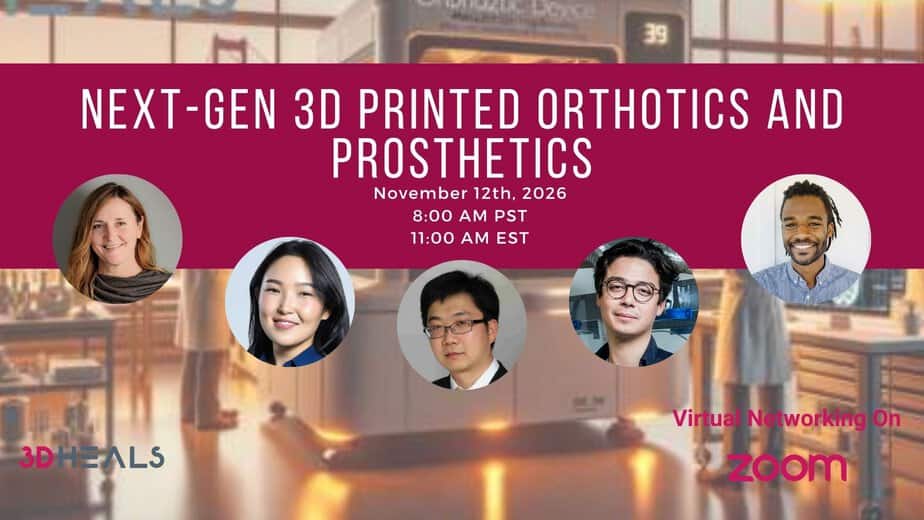
In 2026 the market is about $2.3 billion for 3D-printed prosthetics and more than $5 billion for orthotics. Yet the WHO says only 1 in 10 people who need a prosthesis or orthosis can get one, and more than 75% of low-income countries have no O&P training program. Speakers Jade Ward (RIT AMPrint Center), Tergel Bayarsaikhan (Rightfit), Kaiyan Qiu (Washington State University), Louis-Philippe Broze (Spentys) and Schendy Kernizan (Rapid Liquid Print) will discuss how 3D scanning, AI-assisted design and additive manufacturing are shortening delivery times and bringing a printed below-knee leg down to about $3,000. They’ll also cover the barriers to scaling: reimbursement, socket fit, clinical evidence and workforce shortages. Register now to hear where the market is heading.
Speakers:
Jade Ward

Jade is the Research Development Specialist for the AMPrint Center at the Rochester Institute of Technology. Holding a PhD in Mechanical and Industrial Engineering, her work centers on enhancing prosthetic and orthotic device design using additive technologies, and she has instructed several courses in the field. As a passionate changemaker, Jade received the Bruce R. James Distinguished Public Service Award for her non-profit initiatives to increase access to low-cost 3D-printed upper limb prostheses in low-resource areas. And now, Jade is driving the Center’s engagement with the latest bioprinting innovations in healthcare, integrating technology with biology toward transformative real-world impact.
Tergel Bayarsaikhan
Tergel Bayarsaikhan is the founder and CEO of Rightfit, a Mongolia-based medtech company building an AI-assisted orthotic design platform with outcome tracking, optimized for 3D printing. Rightfit enables clinicians to design patient-specific ankle foot orthoses and print them locally on desktop printers, bringing custom orthotics to patients in a country with no formal prosthetics and orthotics profession.
He holds an MSc in Architectural Engineering from Budapest University of Technology and Economics, where he researched 3D printing with recycled materials. His first medical 3D print was a grip to help his grandmother hold a kitchen knife, which set him on the path to founding Rightfit in 2023.
Kaiyan Qiu
Kaiyan Qiu is the Berry Family Assistant Professor in the School of Mechanical and Materials Engineering at Washington State University. He received his Ph.D. from Cornell University and completed postdoctoral training at Dartmouth College, Princeton University, and the University of Minnesota. Drawing on his expertise in 3D printing and functional materials, Dr. Qiu’s research focuses on the design, manufacturing, and application of 3D-printed biomedical devices, including wearable biosensors for health monitoring, haptic electronics and prosthetic systems for rehabilitation, and artificial organs for surgical applications. His highly interdisciplinary research has resulted in numerous publications in high-impact journals and multiple patent applications, earning broad national and international recognition. He has also established extensive collaborations with researchers and practitioners across engineering, medical schools, hospitals, and industry. More information is available at www.kaiyanqiu.com.
Louis-Philippe Broze
Louis-Philippe Broze is the co-founder and CEO of Spentys, a medical technology company helping orthotics and prosthetics professionals adopt digital workflows. By combining 3D scanning, modelling and printing technologies, Spentys enables clinicians to create personalised devices tailored to each patient while simplifying the production process.
With a background in business engineering and a longstanding interest in healthcare innovation, Louis-Philippe brings an entrepreneurial perspective to the adoption of new technologies in clinical practice. His work focuses on making personalised orthopaedic care more accessible and helping healthcare professionals translate digital innovation into practical benefits for their patients.
Schendy Kernizan
Schendy Kernizan is the co-founder and CEO of Rapid Liquid Print (RLP), an MIT spin-off pioneering gravity-free manufacturing. RLP prints objects directly inside a reusable gel, eliminating the molds, supports, and layer-by-layer limits of conventional 3D printing to produce industrial-grade elastomer parts for healthcare, fashion, automotive, and beyond. Under his leadership, RLP has launched its Levity platform and is backed by investors including BMW i Ventures, HZG Group, MassMutual, and Cambrena.
Before RLP, Schendy co-directed MIT’s Self-Assembly Lab, leading researchers and delivering projects for partners including Google, BMW, and Steelcase, with work exhibited at the Venice Architecture Biennale. Born in New Jersey and raised in Haiti, he led rebuilding efforts after the 2010 earthquake, founding a design firm and raising over $5 million for school and shelter reconstruction. He is a 2026 TED Fellow and speaker (“The gravity-defying future of manufacturing”) and a former Architecture for Humanity Design Fellow.
Reviews
There are no reviews yet.