Interview: Dr. Markus Reiterer, Senior Principle Scientist, Medtronic

 
blank 
Markus Reiterer, grew up in Austria and received both his Dipl.-Ing. (M.S.) and Doctorate (Ph.D.) from the University of Leoben in Austria. During his graduate studies, Markus was employed as Research Associate at the Fraunhofer-Institute for Mechanics of Materials in Freiburg, Germany. In 2004 Markus joined Sandia Natl. Labs as Post-Doctoral Appointee, where he continued his research in computational simulation of sintering of ceramics. He is an internationally recognized expert in mechanics of granular media and theory of sintering.
 Since joining Medtronic in 2006, Markus has been subject matter experts in many projects critical to quality or revenue. He is known as an expert for FEA of materials with complex behavior, high cycle fatigue, welding and joining, and tribology. Markus is a member of the Pan-Medtronic working group in computer modeling and simulation. He has been at the forefront of the development of realistic human simulation at Medtronic. In 2015 he co-authored a roadmap on “In Silico Clinical Trials” which was the product of the Avicenna Coordination Support Action. Since the inauguration, Markus board member of the Avicenna Alliance for Predictive Medicine. In 2017 Medtronic joined the Advanced Regenerative Manufacturing Institute (ARMI), where Markus represents Medtronic’s interests.
 Markus has been successfully leading several Medtronic – University collaborations, given multiple invited talks at the international conference, co-organized several international conferences, published 18 peer-reviewed papers, frequently serves as a journal reviewer. Markus holds 9 patents. In the past couple of years, Markus has gained interest in non-technical aspects of problem solving and concepts of critical thinking. Dr. Markus Reiterer will be a speaker at the #3DHEALS2018 conference on April 20-21st, 2018. 
Jenny: When was the first encounter you had with 3D printing? What was that experience like? What were you thinking at that moment?

Markus: I had my first exposure to 3D printing and metals additive manufacturing in the early 2000s when the Fraunhofer ILT investigated Selective Laser Sintering. At that time, I worked on sintering of ceramics and metals and I understood how important process control is to achieve quality products. I didn’t really believe that hi-rel part, i.e., for airplane engine could ever be built by AM. I must admit that those early parts didn’t look too good. Later, I was involved in miniaturization of 3D printing of polymers with two-photon-polymerization and powder bed methods for metals.
Jenny: What inspired you to start your journey/company/career/research in 3D printing (bio-fabrication/bio-printing)?

Markus: My journey with 3D printing really started in 2013, when I learned about the ability to print multi-material constructs to integrate functionality into materials/components I became very interested and bought a printer that can lay down polymer and metal inks to create 3D electronic components. I became interested in bioprinting when I investigated options to bioengineer replacement organs in 2014. Since then I have followed advancements in both bioprinting and decellularization methods.
Jenny: Who inspired you the most along this journey in 3D printing (bio-printing/bio-fabrication)? This can be a mentor, a patient, a celebrity, anyone basically. You can name more than one as well.

Markus: There is no specific person who has inspired me on my journey in 3D Printing. However, the person who is responsible for my interest in science and engineering is the 1986 physics Nobel Laureate Heinrich Rohrer, who invented the scanning tunneling microscope.
Jenny: What motivates you the most for your work?

Markus: I am motivated by two factors – my general curiosity and by the fact that as a medical device engineer I can have positive impacts on the lives of many, many people.
Jenny: What do you think is (are) the biggest challenge(s) in 3D Printing/bio-printing? What do you think the potential solution(s) is (are)?

Markus: 3D Bioprinting needs to overcome the valley of death of innovation. Scalability to mass produce tissues needs to be demonstrated soon to capitalize on the excitement that we currently experience. We need better equipment, better and more controlled raw materials, and better process control. In addition, academics, industry, and government regulators need to start a conversation about the regulatory path for engineered tissues and organs soon, so that a regulatory framework exists when the first products are ready for in the human application.
Jenny: If you are granted three wishes by a higher being, what would they be?  

Markus: I would ask to win the lottery to have the funding to create a research center for materials in bio- and environmental engineering applications in a beautiful place.
Jenny: What advice would you give to a smart driven college student in the “real world”? What bad advice you heard should they ignore?

Markus: I would advise a student to follow their passion and expose themselves to the most challenging environment they feel just not comfortable to handle. I would advise them to not only look at the ranking of a school or department when choosing a school.
Jenny: What was/is the biggest risk you took in your career?

Markus: Moving to the United States.
Jenny: What do you enjoy in your spare time? What are you passionate about outside of your work/3d printing?

Markus: Cooking, listening to music, and skiing.
Jenny: What is your favorite quote? Why?

Markus: Einstein said,” If I had 60 minutes to solve a difficult problem, I would use 55 minutes in trying to understand the  problem and 5 minutes to solve it.”


blank

Interview: Dr. Jeffrey Miner, Founder and Chief Scientific Officer for Viscient Biosciences

blank
Jeffrey N. Miner is a Founder and Chief Scientific Officer for Viscient Biosciences. Prior to Viscient, Dr. Miner held research leadership positions at Ardea Biosciences, a member of the Astrazeneca group, and Ligand Pharmaceuticals.  His responsibilities at Ardea covered the Biology program as it relates to the discovery, preclinical, translational and clinical development.  He was head of molecular and cellular biology at Ligand Pharmaceuticals.  He is a Faculty Advisor and Molecular Biology Institute Associate at San Diego State University and is a scientific advisory board member for ARTA Bioscience.  His Ph.D. graduate work was conducted in virology at Oregon State University with a post-doctoral fellowship at the University of California San Francisco in glucocorticoid gene regulation. He has drug discovery experience in the Inflammation, Oncology, Endocrine and Cardiovascular drug discovery therapeutic areas and his work has led to or enhanced the development of multiple marketed compounds. His target expertise includes Nuclear Receptors, Kinases, and Transporters.  He has published over 60 peer-reviewed articles and book chapters and is an inventor on multiple patents. Dr. Miner will be a speaker at the #3DHEALS2018 conference on April 20-21st, 2018. 
Jenny: When was the first encounter you had with 3D printing? What was that experience like? What were you thinking at that moment?
Jeff: I saw a presentation by a scientist at Organovo.  They had what looked like a model for a normal liver function from transporters to metabolic enzymes, together with cellular context.  This immediately said to me – Disease models could be transformative here.
Jenny: What inspired you to start your journey/company/career/research in 3D printing (bio-fabrication/bio-printing)?
Jeff: My view of the value of 3D technology in drug discovery coupled with meeting and discovering a shared vision with Keith Murphy, the former CEO of Organovo.
Jenny: Who inspired you the most along this journey in 3D printing (bio-printing/bio-fabrication)? This can be a mentor, a patient, a celebrity, anyone basically. You can name more than one as well.
Jeff: Keith Murphy had this vision a decade ago and has worked to realize it.
Jenny: What motivates you the most for your work?
Jeff: The opportunity to directly impact patient suffering through the development of efficacious medicines.
Jenny: What is/are the biggest obstacle(s) in your line of work? If you have conquered them, what were your solutions?
Jeff: Understanding the biology of the disease and the targets is the greatest challenge due to the complexity, the solutions come slowly from difficult, careful experimentation.
Jenny: What do you think is (are) the biggest challenge(s) in 3D Printing/bio-printing? What do you think the potential solution(s) is (are)?
Jeff: Challenges: Clinical translation and complete disease modeling.   Solutions:  The application and iteration of 3D models, but it will take a lot of work and the climbing of a steep learning curve that we’re just starting to ascend.
Jenny: What advice would you give to a smart driven college student in the “real world”? What bad advice you heard should they ignore?
Jeff: Good Advice: Ask questions and listen to the answers, then ask another question based on that answer.  Bad advice : be afraid to ask questions.
Jenny: If you could have a giant billboard to promote a message to millions and even billions of people in our community (i.e. healthcare 3D printing and bio-fabrication), what message would that be?
Jeff: Keep up the great work, you will change healthcare.
Jenny: What were/was the best investment you made in 3D printing/bio-printing/bio-fabrication?
Jeff: Deciding to couple my skills in drug discovery and development with the powerful tools of 3D bioprinting to take pharma discovery to the next level.
Jenny: What were/was the worst investment you made in 3D printing/bio-printing/bio-fabrication?
Jeff: No bad investments yet, stay tuned.  Failure begets learning so investments all have value unless you aren’t thinking things through to know the risk profile and next moves.
Jenny: What was/is the biggest risk you took in your career?
Jeff: It would have been riskier NOT to found Viscient than it was to found it because we’d never know what we could have accomplished.
Jenny: What do you enjoy in your spare time? What are you passionate about outside of your work/3D printing?
Jeff: Birding, Rock climbing, Mountain biking, public science education
Jenny: What is your favorite quote? Why?
Jeff: “People saying something is impossible are often interrupted by others doing it”.  –  Why?:  We have no idea what is possible, period.
Jenny: What does the word “3DHEALS” mean to you? =) 
Jeff: You have 3 deals for me, said with an English accent.


blank

Interview: Dr. Nima Massoomi, Board Certified Oral and Maxillofacial Surgeon

blank
A New York native, Dr, Nima Massoomi is a Board Certified Oral and Maxillofacial Surgeon who attended the University of Pennsylvania where he received his Dental and Masters in Education. He then attended Medical school at Vanderbilt University where he also completed his Oral Surgery residency in 2007. This was followed by a Cosmetic surgery fellowship in 2008 at Ohio State alongside Dr. T. William Evans, fine-tuning his skills in the management of the soft-tissue and skin. He is currently a clinical instructor at the Department of Oral Surgery at the University of Pacific in San Francisco and maintains two practices in San Francisco and Cupertino. He has lectured nationally and internationally on the use technology in oral surgical procedures, with a goal of improving surgical outcomes using CBCT technology. Most recently, he was part of the team that brought to market the first FDA-approved robot “Yomi” for Dental Surgery in January 2017. This was after many years of collaboration with a team of scientists and engineers at Neocis in Miami, Fl. The Yomi robot will have the capabilities of performing a wide variety of oral surgical procedures, based on 3D CBCT data, being able to provide same-day surgery from start to finish. Dr. Nima Massoomi will be a speaker at the #3DHEALS2018 conference on April 20-21st, 2018. 
Jenny: When was the first encounter you had with 3D printing? What was that experience like? What were you thinking at that moment?
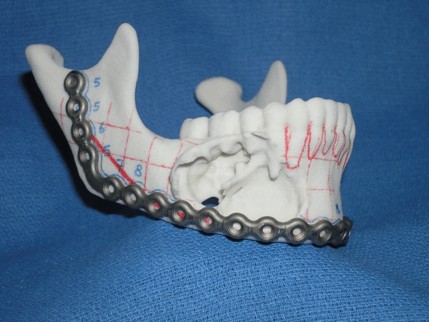
Nima: Approximately 15 years ago, I became involved in 3D printing when I was in medical school as we prepared to remove a tumor from a patient’s lower jaw.  We worked with a company called “Medical modeling” who 3D printed a model of the patient’s skull with the tumor anatomy and vital structures such as nerves, in order to plan our surgical approach.  This allowed us to pre-bend the plates that would be required during the tumor resection surgery.  This was only made possible creating a surgical template using CBCT imagery.  Even back then I thought this was so cool and revolutionary, to preplan surgeries prior to even making an incision.  Today, many companies are even pre-printing custom-made plates for these types of cases!       
blank blank                                             
Jenny: What inspired you to start your journey in 3D printing (bio-fabrication/bio-printing)?
Nima: Honestly, it was the ability to provide better and more precise care to my patients.  It is my belief that if technology can be used to better patient outcomes, then it should be employed to its fullest extent. 
Jenny: Who inspired you the most along this journey in 3D printing (bio-printing/bio-fabrication)? This can be a mentor, a patient, a celebrity, anyone basically. You can name more than one as well.
Nima: It really wasn’t a particular person, but I have to thank my the chairmen of my OMFS surgery department, Dr. Samual McKenna, and Dr. Scott Boyd, who was back then even willing and open to such ideas. 
Jenny: What motivates you the most for your work?
Nima: Improving my patient’s lives and making them smile. This can range from the simplest form of dental injury which can include the loss of a front tooth, to the more devastating injuries from extensive facial trauma. 
Jenny: What is/are the biggest obstacle(s) in your line of work? If you have conquered them, what were your solutions?
Nima: Data. I think all of us in the 3D printing field have to generate data to validate the use of this technology.  I have been working closely with the faculty at University of Pacific Dental School to publish 2 papers on the accuracy of 3D printed material and how it affects outcomes.  More papers are in the works.
Jenny: What do you think is (are) the biggest challenge(s) in 3D Printing/bio-printing? What do you think the potential solution(s) is (are)?
Nima: For the practitioners that are interested in using this technology, the expense of the equipment and the materials to start down this journey can be overwhelming. Additionally, it’s the lack of “cross-breeding” of ideas.  For instance, I am currently working on solving a problem for an oral surgery procedure and need something printed in 3D printing using metal.  However, I have no idea who has done this in the other fields and if they have, is it FDA approved to use in the surgical realm?
Jenny: If you are granted three wishes by a higher being, what would they be?
Nima: Make 3D printing universal, cheaper and faster. 
Jenny: What advice would you give to a smart driven college student in the “real world”? What bad advice you heard should they ignore?
Nima: To make AI, 3D printing a part of their schooling.
Jenny: If you could have a giant billboard to promote a message to millions and even billions of people in our community (i.e. healthcare 3D printing and bio-fabrication), what message would that be?
Nima: “Got 3D? We do!”
Jenny: What were/was the best investment you made in 3D printing/bio-printing/bio-fabrication?
Nima: The treatment planning software that I use on a daily basis to create surgical guides/templates to perform surgery
Jenny: What were/was the worst investment you made in 3D printing/bio-printing/bio-fabrication?
Nima: I don’t think I have made one yet….time will tell?
Jenny: What was/is the biggest risk you took in your career?
Nima: Again, I think its too soon to answer that. Ask me in 10 years!
Jenny: What do you enjoy in your spare time? What are you passionate about outside of your work/3d printing?
Nima: Mission trips and volunteer work here in the US and internationally.  Also trying newer adventures, such as robotics in the oral surgical procedure. 
Jenny: What is your favorite quote? Why?
Nima: Mahatma Gandhi “live as if you were to die tomorrow, Learn as if you were to live forever.”
Jenny: What does the word “3DHEALS” mean to you? =) 
Nima: 3D can heal.


Related Articles:

Interview: Mr. Shashi Jain, IoT Innovation Manager at Intel Corporation

blank

Interview: Jeffrey Sorenson, President and Chief Executive Officer of TeraRecon

blank
Jeff Sorenson is the President and Chief Executive Officer of TeraRecon. He is responsible for ensuring that TeraRecon remains an innovative company with excellent relationships with its customers, employees, shareholders and the medical imaging community. He has been instrumental in achieving growth, increased customer satisfaction and the commercialization of disruptive new technologies. Mr. Sorenson will be a speaker at the #3DHEALS2018 conference on April 20-21st, 2018. 
Jenny: When was the first encounter you had with 3D printing? What was that experience like? What were you thinking at that moment?
Jeff: As CEO of an advanced visualization company, 3D printing was always a capability we supported, so it has been so long ago that it is difficult to remember. What was remarkable, was the first time I saw a print using a new direct 3D image to 3D print technology we were experimenting with – it is truly ‘what you see is what you get.’ A great multi-color glossy print of human anatomy that is life-like and life-size is truly stunning. We all know where our heart is, and about what size it is. But, when you put a lifelike 3D print in your hand it seems to erase what you thought and allow you to connect with the reality of that heart being a part of you. This is true to an even greater extent for patients, and it is so powerful. In the end, we introduced this new approach for generating these remarkable 3D prints, which debuted at RSNA16 and was shown at 3DHeals 2017.
Jenny: What inspired you to start your journey in 3D printing (bio-fabrication/bio-printing)?
Jeff: Honestly, it was not my vision that brought the company into 3D printing. It was Gael Kuhn, Director of Product Management at TeraRecon. He jokes that the toughest part of making our 3D Print Pack Portal was convincing me that we should do it. The market is quite small and uncertain, but we see unmatched levels of interest in 3D printing, second only to artificial intelligence for image processing.
Jenny: What motivates you the most for your work?
Jeff: I am passionate about building great people, and having fun. A hard-charging team that has permission to fail and knows that they will get credit for their successes is what creates a workday that is more like a playday. Patient care sometimes seems broken from a business perspective, and yet miraculous from humankind perspective. We must find technology solutions to most of these problems. Healthcare providers are technology companies now. They both manufacture and consumer technology, just as they do with 3D models. I am seeing a very synergistic tie between the image processing intelligence of AI and the need for more automated or even fully automated 3D segmentation tools. The same technology allows realistic, anatomic models to be viewed in an augmented reality headset instead of needing to be printed at all.  The lines are blurring when it comes to imaging workflows that are viewed in the screen, or hover in the air out of the screen, and of course can then be 3D printed and placed in your hand. When models are digital, you can do more with them, like ‘walk’ into them. When they are printed, they last forever and provide a tactile experience. There has never been a more exciting time to be involved in the translation of source medical images into works of information and art.
Jenny: What is/are the biggest obstacle(s) in your line of work? If you have conquered them, what were your solutions?
Jeff: 3D printing was too cumbersome for many years. Using industrial types of segmentation software produced models that were sometimes imagined and then sculpted in the processing tools. They were far too time-consuming to produce, and not very realistic. In addition, the price of a printer could not be justified by the actual workload. To solve these problems, we created a way that our iNtuition medical grade segmentation tools could be applied to quickly create an output file that carried with it all the beauty, color and realism of the image in the iNtuition workstation. In addition, we created a portal that can print these files using a cloud printing service that dramatically reduces the fully-burdened per-piece cost.
Jenny: What do you think is (are) the biggest challenge(s) in 3D Printing/bio-printing? What do you think the potential solution(s) is (are)?
Jeff: The price per cubic centimeter for a model is dropping rapidly. The technology is becoming more and more accessible. But, still, models are in the range of $50 to $500 when an entire imaging interpretation has reimbursement on the low end of this range. When it is too expensive to print the models, then don’t. There is a strong argument for holographic or even simple interactive pictures with 3D renderings appearing as they do in a video game, or as we do in advanced visualization today. It is the convergence of all of these technologies and their appropriate use that will unlock the potential of all of the technologies. They are all better together.
Jenny: What advice would you give to a smart driven college student in the “real world”? What bad advice you heard should they ignore?
Jeff: The idea that cool companies are breezy and fun, people wear trendy beards and just hire smarter people is really a damaging false expectation. Things that are hard, are hard for everyone. The young trendy people are actually at least mid-thirties, and in larger companies, the people standing behind them are older than that. What is cool, is innovation, hard work, flexibility and team trust. From these things come to all other things.  Finally, don’t chase money because it just comes automatically to those that are high value. Becoming high value is what you should chase. Pursue knowledge with an insatiable curiosity. Interestingly enough, this is how we ended up in the 3D printing space. We were curious as to why we could not get our beautiful iNtuition 3D renderings into the printer. It required some research and a technology solution, which was a converter that takes our DICOM saved states made by radiologic technologists and converts them into the full volume, high-quality printable PC files. No STL files, whatsoever.  That’s cool!
Jenny: If you could have a giant billboard to promote a message to millions and even billions of people in our community (i.e. healthcare 3D printing and bio-fabrication), what message would that be?
Jeff: It’s easy! 3D printing does not have to be hard. We should not need 3D printing programs in technical colleges. There are already medical image segmentation and rendering tools available that far surpass what is being used. Radiologic technologists are trained in anatomy and the use of these tools. We seem to be stuck in a rut where industrial segmentation software tool uses STL files, loose clarity and resolution, are hard to use, are time intensive, and are not being rapidly adopted.  People are too expensive to have them spending hours and hours per print. Isn’t it interesting that we talk a lot about the fixed cost of printing, but keep propagating an impractical workflow? Using real medical-grade advance visualization tools and being willing to stay in the digital world when it makes sense, and to print in the material world when it makes sense, makes it all simpler, better and more affordable.
Jenny: What was/is the biggest risk you took in your career?
Jeff: I began my career at Philips Medical Systems as a field service engineer. It grew over time into a leadership development program and eventually a paid MBA. Everything was lining up to have a very long and prosperous career at Philips. Through a set of strange circumstances, I ran into my predecessor who used to hold my job. I met him only out of curiosity.  But, with him was another person whom I had heard of before at Philips and who was now working at the same company, Imatron. They successfully recruited me to this little super-fast CT scanner company that had a product that could image the heart when no other CT scanner could. I left the security behind, with my wife pregnant with our first child, and took a big risk that being a big part of a small company would allow me to learn faster than being a small part of a big company. While we had our challenges and it was not easy, the company was turned around and sold to another big company, GE Medical Systems. It was because of this risk that I took that I learned marketing, sales, product management, advanced image processing techniques, and began working with companies like my current employer, TeraRecon. The broader knowledge and cross-functional experience that I gained has defined my career, prepared me for my current role, and directed my career toward 3D image processing, including the 3D printing solutions that have brought me to become a part of 3DHeals.
Jenny: What is your favorite quote? Why?
Jeff: “None of us is as smart as all of us” 
― Kenneth H. Blanchard
People engage when they are heard and disengage when they are ignored. Solving big problems requires people and passion. Human beings want to contribute and add value. We take pride in our work and are honored when our work is recognized. The best way to ignite team collaboration and spawn new ideas is to make sure voices are heard and influences come from both inside and outside of the organization.
Jenny: What does the word “3DHEALS” mean to you? =)
Jeff: I think it means that 3D printing can help heal patients and that it belongs in the realm of primary diagnosis and treatment regimens. Because “printing” is not in the name, I also take it to mean that 3D “heals” this way, inclusive of holography, advanced visualization, AI image processing and any other forms of innovation. 

Related articles:

Interview: Dr. Sanjay Prabhu, Pediatric Neuroradiologist at Boston Children’s Hospital and Assistant Professor of Radiology at the Harvard Medical School

Interview: Dr. Sujatha Buddhe, Pediatric 3D Printing, Seattle

Interview: Gray Chynoweth, Chief Membership Officer for ARMI | BioFabUSA

blank

Interview: Robert Wesley, 3D Printing Engineer at Washington University Medical Campus, St. Louis Children’s Hospital

 
blank
Robert Wesley, 3D Printing Engineer, 3D Printing Center at Washington University Medical Campus, St. Louis Children’s Hospital, BJC HealthCare
Robert Wesley is a Tennessee native who started his career at Nicklaus Children’s Hospital in Miami. It was there he was introduced to in-hospital 3D printing. As a biomedical engineer in pediatric cardiac surgery, he worked to expand the hospital’s 3D printing capabilities and vision beyond its congenital heart program. A couple of years later he did consult work for a few southeastern children’s hospitals with emerging 3D printing programs, before finding his way to St. Louis Children’s Hospital of BJC HealthCare. In St. Louis, Robert runs the operations of the 3D Printing Center at Washington University Medical campus which services all 15 BJC hospitals, Washington University School of Medicine, and local/regional hospitals, under the direction of Christine Pavlak, Dr. Shafkat Anwar, Dr. Kamlesh Patel, and Dr. Eric Eutsler.
Jenny: When was the first encounter you had with 3D printing? What was that experience like? What were you thinking at that moment?
Robert: My first encounter with 3D printing was during my first job at Nicklaus Children’s Hospital. Like many, during my final interview, I thought the 3D printing hearts were being implanted in patients. I realized that was naïve at the time, but I was interviewing for a job I didn’t even know existed at other hospitals. On the job, I learned that while the current technology isn’t quite there, there’s still much value in using 3D printed models for surgical simulation, intern/resident education, and patient consultation.
Jenny: What inspired you to start your journey/company/career/research in 3D printing (bio-fabrication/bio-printing)?
Robert: I started out as a research biomedical engineer fresh out of grad school. I wasn’t sure what I wanted to do, but I knew I wanted to contribute to the existing body of work. I keep up-to-date on what is happening within this unique industry. I was challenged with acquiring a large scale 3D printer too expensive for an existing budget. I poured a lot of time into researching the clinical and dollar value of a smaller service and creating projections for what it could return to the hospital with a larger program.
Jenny: Who inspired you the most along this journey in 3D printing (bio-printing/bio-fabrication)? This can be a mentor, a patient, a celebrity, anyone basically. You can name more than one as well.
Robert: Robert Hannan and Dr. Redmond Burke
Jenny: What motivates you the most for your work?
Robert: I think the greatest motivation comes from patients, people I don’t even see 99% of the time. I have to believe that what I’m doing will help make a difference in their care.
Jenny: What is/are the biggest obstacle(s) in your line of work? If you have conquered them, what were your solutions?
Robert: The biggest obstacles in my line of work plague many others. There’s no health insurance reimbursement for 3D printed models used for patient care. The materials and/or equipment are expensive to buy and maintain. Many believe that this level of 3D printing is plug-and-play with a turn-around time of minutes or hours within the same day.
Jenny: What do you think is (are) the biggest challenge(s) in 3D Printing/bio-printing? What do you think the potential solution(s) is (are)?
Robert: The price of larger scale machines and materials create a problematic barrier to programs that don’t have a budget to match.
Jenny: If you are granted three wishes by a higher being, what would they be?
Robert: Greater adoption, reimbursement, and more rapid development of these technologies.
Jenny: What advice would you give to a smart driven college student in the “real world”? What bad advice you heard should they ignore?
Robert: I can’t remember when or where I heard this, or if I had thought of it on my own before hearing it, but you often hear that a biomedical engineer is “a jack of all trades and a master of none.” Keeping this terrible saying in mind, you will be challenged for what you think you’re worth, what you know, and what you’re capable of learning on the job. The job market tends to look better with the more experience and education you accumulate. If you stay committed to what you want to do and continue to learn about it, one day you’ll be the expert in almost any room you walk in and the people you work with will look to you for answers.
Jenny: If you could have a giant billboard to promote a message to millions and even billions of people in our community (i.e. healthcare 3D printing and bio-fabrication), what message would that be?
Robert: “Contact the 3D Printing Center at Center at Washington University Medical Campus for your clinical 3D printing needs.” Is that too much self-promotion? Seriously, I would like to let more people know that this technology exists locally to them. The most accomplished feeling I have is when I 3D print a model for a patient who was previously diagnosed as inoperable (and he/she thrived after surgery).
Jenny: What were/was the best investment you made in 3D printing/bio-printing/bio-fabrication?
Robert: Just like anything else, you get out of it what you put into it. Whenever I would travel for conferences, I lost some of my own money, but I would learn a lot about what others were doing with similar capabilities and I was able to keep up-to-date with what the “rock stars” of the industry were doing.
Jenny: What were/was the worst investment you made in 3D printing/bio-printing/bio-fabrication?
Robert: None.
Jenny: What do you enjoy in your spare time? What are you passionate about outside of your work/3d printing?
Robert: My waking life is currently split in two. Outside of work, I’m usually swimming, cycling, running, racing or traveling for a race. I’ve been racing since I was 15 years old and it has grown from cross country 5Ks to Ironman distance events.
Jenny: What is your favorite quote? Why?
Robert: “To give anything less than your best is to sacrifice the gift.”- Steve Prefontaine”
In whatever you do, you commit to giving the best of yourself to it. Otherwise, what’s the point?
Jenny: What does the word “3DHEALS” mean to you? =)
Robert: Current and future innovations through collaboration.


blank

Interview: Dr. Melanie Matheu, Co-founder of Prellis Biologics

blank
Dr. Matheu co-founded Prellis Biologics in October 2016, with the mission to create fully vascularized human tissues and organs for transplantation. Her realization that the tiny blood vessels necessary for creating human organs could be replicated using the laser technology at the center of her PhD thesis work, led to development of the blended engineering and biology approach Prellis is using to solve the human organ shortage. Dr. Matheu is an expert in laser-based imaging of the immune system and developed Prellis’ platform technology. She brings her multi-disciplinary experience in specialized laser microscopy, cell biology, physiology, and biophysics to address the unsolved biomedical challenge of rapid 3D printing of large, vascularized tissues. Dr. Matheu will be a speaker at the #3DHEALS2018 conference on April 20-21st, 2018.
Jenny: When was the first encounter you had with 3D printing? What was that experience like? What were you thinking at that moment?
Melanie: I first encountered 3D printing in a research lab when I was still in academia. I was fascinated by the freedom of iteration and development 3D printing provided.  I immediately started thinking about the implications for healthcare and medicine.
Jenny: What inspired you to start your journey in 3D printing (bio-fabrication/bio-printing)?
Melanie: When I was doing research at UCSF I was driving home from the lab one night and listening to a podcast on organ development for transplantation. The surgeon being interviewed identified a singular problem standing between scientists and physicians and a truly living engineered organ. Once I heard it, it seemed simple; develop microvasculature. I couldn’t shake the idea that all we had to do was find a way to create microvasculature quickly and we could save millions of lives. At its core, this is an engineering problem, but one that typically only people with a solid footing in the cell biology world would be excited about solving. I had solid exposure to both sides of the problem and I began to look for and thinking about possible solutions.
Jenny: Who inspired you the most along this journey in 3D printing (bio-printing/bio-fabrication)? This can be a mentor, a patient, a celebrity, anyone basically. You can name more than one as well.
Melanie: I’ve had a number of incredible mentors, one that was particularly important in guiding my scientific career was my Ph.D. mentor Mike Cahalan, Ph.D. of UC Irvine. Mike is a careful, thoughtful, and thorough scientist, who took incredibly ‘what if’ and ‘let’s try and see’ moments, and turned them into elegant research, advancing the field of immunology in phenomenal ways. Thanks to Mike’s work we understand that immune cell activity is controlled by ion channels and that immune cells are highly motile in all tissues throughout the body, nd critical for immune system function. He’s also a genuinely great person who has always given meaningful advice.
Jenny: What motivates you the most for your work?
Melanie: I love solving challenging problems, it’s a privilege to have the chance to work on a well-defined problem that has the potential to impact the lives of millions in a positive way.
Jenny: What is/are the biggest obstacle(s) in your line of work? If you have conquered them, what were your solutions?
Melanie: Communicating a cross-disciplinary solution in a way that makes sense to a broad audience is always a challenge. We’ve found it often works best to explain the exciting potential of the solution, the magnitude of the problem, and then give some real-world physical examples.
Jenny: What do you think is (are) the biggest challenge(s) in 3D Printing/bio-printing? What do you think the potential solution(s) is (are)?
Melanie: Some of the largest challenges facing 3D printing are standardization and quality control testing. We’ve placed amazing tools in the hands of very smart people, but making sure there is medical grade consistency across the board will allow for the field to move from one-off production into the realm of true medical solutions.
Jenny: If you are granted three wishes by a higher being, what would they be?
Melanie:
Great question!
I have a love of promoting education and I think I would start there.
I’d wish for improved general education in the sciences.
More coursework addressing cross-disciplinary interaction in the sciences, especially in solving difficult problems. I think this is where great solutions are often found.
Jenny: What advice would you give to a smart driven college student in the “real world”? What bad advice you heard should they ignore?
Melanie: Make sure to remember that you can choose which advice is meaningful to you. I tend to pay attention to the advice of people I respect when it resonates with my inner passion and drive. Therefore my advice is to find your inner passion and drive first and then everything else will align.
For better or worse I’m also the type of person who tends to hear the words ‘can’t’ ‘won’t’ ‘don’t’ and ‘impossible’ as interesting challenges. So I typically didn’t give much credence to negative advice.
Jenny: If you could have a giant billboard to promote a message to millions and even billions of people in our community (i.e. healthcare 3D printing and bio-fabrication), what message would that be?
Melanie: Dream about how to achieve the impossible, make it possible, then doing the impossible becomes easy.
Jenny: What were/was the best investment you made in 3D printing/bio-printing/bio-fabrication?
Melanie: Our company is building a novel type of 3D printer, it is laser-based and ultra-fast. My greatest investment personally was boot-strapping the founding of this company and the filing of the patents. It was a leap of faith, I checked all of the physics and then took the leap. Seeing the system print as we expected it too for the first time was breathtaking. After that our investors and I have developed this out into its third generation, a system that is printing biological materials faster than any other known technology.
Jenny: What was/is the biggest risk you took in your career?
Melanie: When I left academia, I had just been awarded a transitional grant, I left a fully funded position and a bright academic future to start over in biotech and learn something new.
Jenny: What do you enjoy in your spare time? What are you passionate about outside of your work/3d printing?
Melanie: I love long distance running. I’m also a very visual person so I still work on making art occasionally.
Jenny: What is your favorite quote? Why?
Melanie: When a distinguished but elderly scientist states that something is possible, he is almost certainly right. When he states that something is impossible, he is very probably wrong.
– Arthur C. Clarke
This is one of my favorite quotations because I believe we too often accept the boundary of other’s knowledge as truth. As a scientist, I believe it is our responsibility to continue to ask questions and explore possibilities around the edges of knowledge.
It is only by following your deepest instinct that you can lead a rich life, and if you let your fear of consequence prevent you from following your deepest instinct, then your life will be safe, expedient and thin.
-Katharine Butler Hathaway
This quote always reminds me that it is more often the lack of action we regret than taking action or exploring something new.
An adventure is only an inconvenience rightly considered. An inconvenience is an adventure wrongly considered.
-G. K. Chesterton
I always refer to this quote when the unexpected occurs.
Jenny: What does the word “3DHEALS” mean to you? =)
Melanie: 3DHEALS, to me, describes, a new world of possibilities at the intersect of engineering and medicine.

 Articles you may also like: 

Interview: Dr. Albert Folch, Professor of Bioengineering at University of Washington

blank

Interview: Dr. Michael D Scherer On Digital Dentistry – "The original guides were printed in Europe, had to travel via customs, and were incredibly expensive. Looking back, it was a paradigm shift. Wow, things have changed!"

blank
Dr. Michael Scherer is an Assistant Clinical Professor at Loma Linda University, a Clinical Instructor at University of Nevada –Las Vegas, and maintains a practice limited to prosthodontics and implant dentistry in Sonora, California. He is a fellow of the American College of Prosthodontists, has published articles, DVD training series, and in‐person and online courses related to implant dentistry, clinical prosthodontics, and digital technology with a special emphasis on implant over dentures. As an avid technology & computer hobbyist, Dr. Scherer’s involvement in digital implant dentistry has led him to develop and utilize new technology with CAD/CAM surgical systems, implement interactive CBCT implant planning, and outside of the box radiographic imaging concepts. Dr. Scherer also maintains two online courses: 1‐ Fast‐Track Digital Dentistry & 3D Printing, 2‐ Fast‐Track Full‐Arch Reconstruction Implant Overdentures, and five YouTube channels: “LearnLOCATOR”, “LearnLODI”, “LearnSATURNO”, “LearnLOCATOR F‐Tx” and “The 3D Dentist”‐ popular YouTube channels on dental implant procedures and digital dentistry.
Dr. Scherer will be a speaker at 3DHEALS2018.
Jenny: When was the first encounter you had with 3D printing? What was that experience like? What were you thinking at that moment?
Michael: Thank you for the opportunity to have this interview! I began working with 3D printing early in practice in the form of surgical templates to assist in dental implant positioning. The original guides were printed in Europe, had to travel via customs, and were incredibly expensive. Looking back, it was a paradigm shift. Wow, things have changed!
Jenny: What inspired you to start your journey/company/career/research in 3D printing (bio-fabrication/bio-printing)?
Michael: To democratize the system and make printing available via reasonably priced systems, open-source software, and printers that were available to clinicians around the world. I knew from day 1 that it was going to be big for clinical dental practice, but there were so many barriers to implementation. Slowly but surely we have begun to break down each one of those and are starting to see the proliferation of desktop-grade printers in our industry.
Jenny: Who inspired you the most along this journey in 3D printing (bio-printing/bio-fabrication)? This can be a mentor, a patient, a celebrity, anyone basically. You can name more than one as well.
Michael: When I got started with these workflows, very few or even any other dentists were actually using 3d printers in their practices. There were early leaders in 3D printing techniques within dentistry, such as Dr. Ganz who is a leader in 3D imaging and some of the incredible people at Loma Linda University Implant Dentistry department and their pioneering work in “rapid prototyping” of mandibles for dental implant reconstruction in 1983-1985.
Jenny: What motivates you the most for your work?
Michael: I am motivated by being able to see the smiles on my patients’ faces when I show them what we can do with dental 3D printing and modern technology. I have one patient, Jan, who is an older lady that loves rubber ducks. I asked her to bring in her favorite rubber duck and I offered to print an exact copy of it. Using my dental x-ray machine, I was able to scan the duck, create a model out of it, and then 3D print one for her. I was blown away by how touched she was… and will never forget her smile.
Jenny: What is/are the biggest obstacle(s) in your line of work? If you have conquered them, what were your solutions?
Michael: People who say it can’t be done. There are many naysayers and those who have motivations other than improving the quality of care and bringing enhanced access to modern technology. I enjoy the challenge of proving them it can be done.
Jenny: What do you think is (are) the biggest challenge(s) in 3D Printing/bio-printing? What do you think the potential solution(s) is (are)?
Michael: A lack of real and useful biocompatible materials. Regulatory agencies need to make the approval process easier and less expensive than it currently is. We have the computing technology to do almost anything but we don’t have materials that can be used intraorally or those we have are very limited in scope.
Jenny: What advice would you give to a smart driven college student in the “real world”? What bad advice you heard should they ignore?
Michael: Respect your professors yet challenge them every day. Have perspective and ask questions yet understand where we have come from. Do not settle for “this is the way we have always done things” and most certainly never stop pushing.
Jenny: If you could have a giant billboard to promote a message to millions and even billions of people in our community (i.e. healthcare 3D printing and bio-fabrication), what message would that be?
Michael: The most important rule: “You have to have fun while doing this or else it won’t go the distance.” I began this journey when I was young… playing video games. An insane amount of Atari/Nintendo/early Computers. It must be fun to do and not boring, there always should be a challenge, a jump you can’t seem to make in level 9, to keep us going. Like Jobs’ said, “Stay hungry, stay foolish.” I live this mantra daily.
Jenny: What were/was the best investment you made in 3D printing/bio-printing/bio-fabrication?
Michael: Absolutely my first Formlabs printer. It wasn’t my first printer, in fact, I owned 5 of them prior to my first Formlabs, but it was my first printer that just got the job done, rather than spending hours “troubleshooting.”It’s been a really fun journey since then and figuring out what works for dentistry.
Jenny: What does the word “3DHEALS” mean to you? =)
Michael: It’s our commitment to improving worldwide healthcare through the use of additive manufacturing, digital technology, and innovation but also at a reasonable cost. It’s about stoking the fire within each and every one of us to better push ourselves to drive healthcare into the 21st century.

blank

blank

Don’t want a ‘Family’, want a (star) ‘Team’

One thing stroked a chord with me last week while I was listening to a podcast “Masters of Scale with Reid Hoffman” on the culture at Netflix. In particular, the podcast mentioned a public Netflix culture slide deck (link), in which, a slide mentioned that Netflix does not consider itself as a ‘family’, but a ‘team’.
I have to agree 100%.
‘Family’ give us fuzzy and warm feelings. Broadcasting this banner may attract some young graduates who want a wonderful place to work at.
My advice: RUN.
The word ‘Family’ represents un-conditioned love and tolerance. The dark side of this being a company culture, however, is that people often abuse this love and tolerance, and this romanticized view of a working group.  It gives some people, who are either low-producers, true abusers/criminals, and others with poor characters an opportunity to take advantage of this love and tolerance, this culture of being a ‘family. Like during a recent scandal at Wynn, Steve Wynn repeatedly ask his abused employees to consider the company a ‘family’.  When a company claims that it functions like a ‘family’, watch out.
At work, I believe in the law, in pay to play, in fair metrics that are transparent, in a culture of constant innovations. I want to be part of a star pro sport ‘team’, not a family. It is pretty courageous for a company like Netflix to boldly assert that delivering value and constant upgrading itself are its priority, not chasing after a romanticized status that ultimately tolerates low productivity, abuse, and status quo.
That, however, does not mean the employee should not be treated well, paid well, with respect and encouragements. It does not mean a bro-culture like the one at Uber. Needless to say, common sense rules here.
Yes, people can bring dogs to work and can play ping pong during breaks…if it means better productivity and more lit-up light bulbs. But no, I don’t want my company to be a ‘family’, I expect a star ‘team’ playing its best games.

blank

Government Shutdown and 3DHEALS: There is a Connection, Believe or Not

Want to write a piece for 3DHEALS Expert Corner? Email us: info@3dheals.com

On the evening of January 22nd, 2018, 3DHEALS hosted the first pilot executive working conference at the Washington DC office of ReedSmith, a law firm with special interests in liability issues related to 3D printed medical device. The goal of this conference aims to bring executives from different healthcare organizations, additive manufacturing industry, bioprinting and pharma companies, academia, and the government policy experts together to tackle some of the tougher problems facing the healthcare 3D printing and bioprinting industry. In theory, the small group format will allow decision makers in each organization to have a multi-disciplinary conversation, outside of the silo they often found themselves in.
There was no sales pitch in this conference. The goal was one and only: Finding out what are the top challenges facing the industry, and have a conversation to initiate solutions. We named this 3-hour event, “3DHEALS: Taming the Wild West of 3D Printing”, and focused on policy related issues for the attendees. While due to inopportune government shut-down no government entity was present (i.e. FDA, DOD, NIH, etc), the conversations were filled with enthusiasms and inspiration. Below is our meeting minute and we think sharing the notes will be beneficial to everyone in the ecosystem. 
Attendees: Mike Tilkin (American College of Radiology), Ankit Saharan (EOS), Robert Weseley (St. Louis Children’s Hospital), Jay Morris (Mayo Clinic), Lee Dockstader (HP), Celeste Letourneau (Reed Smith), John Jameson (Winningconnections), Ben Holmes (Nanochon), Kara Noack (BASF), Rik Jakobs (3DSystems, NextDent), John Hartner (VC/Digital Industrialist LLC), Matt Jacobson (Reed Smith), Jenny Chen (3DHeals), Daniel Ortiz (3DHeals)

Clinical Trials Group: 9:00 – 9:15 pm

(Participants: Jenny Chen, Celeste Letourneau, Rik Jacobs, Ben Holmes)

Topic 1: Challenges for clinical trials on evidence or efficacy of 3D printing in healthcare.

Group Summary:
Costs:

    • There are several ways to get additional funding for clinical trials. Government funding and funding from non-profit organizations are available. If the clinical trial involves routine care, then the trial is often qualified to participate in cost-sharing coverage (by insurance companies).
    • Starting legal advice early (at phase 1 of trial) can de-risk cost of a trial down the line.
  • Designing a business model to decrease the risk of trial is important.

Design: Design trial also serves to contain cost. To increase the chance of cost containment, strategies include pairing with larger entities (such as NIH), being beyond phase 1 trial, optimizing the timing of the clinical trial. For example, the trial for a rare disease will take longer (i.e. more costly). A well-known, outspoken research sponsor with a rich network will potentially decrease the timing of the trial.
Communication is the key. Picking a good spokesperson (who doesn’t have to be a PR firm) is important. This person should be a good listener and also able to communicate in multiple different industrial languages that are easy to digest. This is especially important when the audience is the government/legislator.
Benefits of conducting clinical trials: Clinical trial can serve side-goal of establishing a pathway to the reimbursement and educate the communities you will get paid from.
Roundtable Discussion:
– A lot of the scientific work takes 5-10 years before attempts at reimbursement discussion.
– Sometimes trials are attempting to provide solutions to problems that don’t exist or doesn’t actually answer the problem.
– A local insurance company in Minnesota will pay for some 3D prints even though CMS will not (becaused of assumed value added).
– Nontraditional funding exists and can be a good source of funding. 

Manufacturing Potential of Hospitals: 9:15 pm – 9:32 pm

(Participants: John Hartner, Matt Jacobson, Jay Morris, Lee Dockstader)

Topic 2: What is the potential for the hospital to become a 3D printing manufacturer?

Group summary:
It is important to define what is a medical device. In common sense, they can include surgical models, surgical guides, implants, and surgical tools. Depending on who you ask, the definition of “medical device” is different in FDA’s lingo versus that of the law (liability law). Even if a diagnostic model causes harm, it’s still held liable.
Roundtable Discussion:
What should be within the scope of the hospital? What should be okay for hospitals to produce?
Several suggestions:
– Non-diagnostic surgical models are okay for hospitals to produce.
– Common opinion: Class II/III medical devices should not be at manufactured the hospital level.
– Are surgical instruments okay? Depending on the resources of the institution, the manufacturer should be accredited.
– Living tissue like live cartilage in wide geographic distribution is not yet a reality. Some larger institutions will have a GMP. In hospital tissue engineering still seems a future possibility.
Eventually, a system or device production in the hospital would have to be accredited by a regulatory body like the ACR. Although the cost of the device goes down with in-house production, the liability and related insurance will go up.

3D printing process vs end device regulation: 9:32 – 9:43 pm

(Participants: Mike Tilkin, John Jameson, Robert Wesley, Kara Noack, Ankit Saharan)

Topic 3: Should regulation be at the 3D printing process or end device level?

Group Summary:
Although 3D printing process regulation/qualification is eventually needed, we are not there yet. It is still more practical to just regulate end device. The process to be regulated will include regulation on materials, sterilization process, manufacturing environment, documentation, and personnel certification.
FDA reviewer knowledge and efficiency vary from one to another. They can be a novice to that specific device/industry. The industry needs to spend more time and efforts to educate the public, including the FDA.
FDA document  (recent technical guidance) is a step forward but still at the leadership level. It will take awhile for it to trickle down to the reviewer level.
Roundtable discussion:
FDA typical approval/clearance pathways: PMA, de novo process, etc. Default goes to PMA, which is the most stringent pathway. Companies should consider going to de novo process. “Me too” process has funding implications and is widely variable.
General discussion
In the Netherlands, after being encouraged by 3D printing entrepreneur, the local dental school now has 3D printing in the dental school curriculum.
It is very important to ensure education and have diverse collaboratives.
ReedSmith White Paper on 3D Printed Medical Device and Liability Law:
o   3D Printing of Manufactured Goods: An Updated Analysis
o   3D Printing of Medical Devices: When a Novel Technology Meets Traditional Legal Principles

Articles you may also like:

Interview: Luiz Fernando Michaelis, Co-founder & CEO of Hefesto Med Tech

Taipei Taiwan Event Recap: 2018 – What’s next after the hype?